
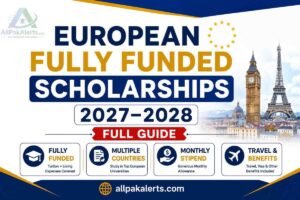
European Fully Funded Scholarships 2027–2028: Full Guide
Apply for Scholarships from Here.
European fully funded scholarships for the 2027–2028 academic year provide international students with complete financial coverage, including 100% tuition fee waivers, monthly living stipends, return airfare, medical insurance, and research grants. Major flagship awards include Erasmus Mundus, DAAD Scholarships (Germany), Swedish Institute Scholarships, and Eiffel Excellence Scholarships (France).
INTRODUCTION
Studying in Europe is a transformative goal for thousands of students worldwide, but the tuition fees and living expenses can present a major financial barrier. European Fully Funded Scholarships for 2027–2028 offer a life-changing solution by funding every aspect of your international higher education.
Whether you are seeking an undergraduate degree, a joint Master’s program across multiple countries, or advanced PhD research, European governments and universities allocate millions of Euros each year to attract top global talent. Host destinations such as Germany, France, Sweden, Switzerland, the Netherlands, Italy, and the UK offer world-renowned universities, innovative research hubs, and vibrant multicultural environments. (European Fully Funded Scholarships)
From the flagship Erasmus Mundus Joint Master’s to national government grants like DAAD in Germany and Stipendium Hungaricum in Hungary, this comprehensive guide walks you through the top funded programs, eligibility requirements, required documents, and step-by-step application strategies to help you secure a scholarship in Europe for 2027–2028.
QUICK OVERVIEW TABLE
| Item | Details |
| Scholarship Name | Top European Fully Funded Scholarships 2027–2028 |
| Host Region | Europe (EU/EEA & UK) |
| Host Institutions | Top Public & Research Universities across Europe |
| Degree Levels | Bachelor’s, Master’s, PhD, & Postdoctoral Degrees |
| Funded By | European Union, National Governments & University Foundations |
| Scholarship Type | Fully Funded |
| Coverage | 100% Tuition, Monthly Stipends (€900–€1,400+), Airfare, Health Insurance |
| Eligible Countries | Open to international students from all continents |
| Application Deadlines | September 2026 – March 2027 (varies by program) |
| Study Mode | Full-time On-Campus / Inter-European Mobility |
| Duration | Bachelor’s: 3–4 yrs | Master’s: 1–2 yrs | PhD: 3–4 yrs |
| IELTS Required | Varies (Many accept TOEFL, Duolingo, or Medium of Instruction letters) |
| Application Fee | Mostly free (varies by university portal) |
ABOUT THE SCHOLARSHIP
Higher education across Europe is renowned for academic quality, research output, and state-backed funding. European governments actively use scholarship programs to foster international cooperation, address global challenges, and attract skilled professionals.
History & Objectives
European funding schemes have expanded rapidly under initiatives like the EU’s Erasmus+ framework and country-specific internationalization grants. These programs aim to build cross-border academic networks, support researchers from developing countries, and provide international experience. (European Fully Funded Scholarships)
Key Scholarship Categories
-
EU-Wide Joint Scholarships: Programs like Erasmus Mundus (EMJM) offer joint degrees where students study in at least two different European countries during their program.
-
National Government Grants: Fully funded national programs such as DAAD (Germany), Eiffel Excellence (France), Swedish Institute Scholarships (Sweden), Swiss Government Excellence Scholarships (Switzerland), and Stipendium Hungaricum (Hungary).
-
University-Specific Merit Awards: Individual top-tier universities (e.g., Gates Cambridge, ETH Zurich Excellence, Holland/NL Scholarship) provide merit-based packages.
Competition Level
Admission to European fully funded programs is merit-based and competitive, with selection rates ranging between 3% and 10% depending on the award scheme. Applications are evaluated on academic background, statement of purpose, research potential, and relevant work or community experience. (European Fully Funded Scholarships)
SCHOLARSHIP BENEFITS
European fully funded scholarships provide comprehensive financial support to ensure scholars can live and study without financial strain:
-
✔ Full Tuition Fee Waiver: Complete exemption from university tuition and administrative enrolment fees.
-
✔ Monthly Living Allowance (Stipend): Generous monthly stipends to cover food, housing, and personal needs.
-
Master’s Level: €900 to €1,400 per month depending on host country.
-
PhD Level: €1,300 to €2,500+ per month.
-
-
✔ International Return Airfare: Annual or travel grants provided to cover flight expenses between your home country and Europe.
-
✔ Installation & Relocation Allowance: Lump-sum grants given upon arrival to assist with initial rental deposits, setup costs, and books.
-
✔ Comprehensive Medical Insurance: Full health, accident, and liability insurance throughout your study period in Europe.
-
✔ Visa & Residence Permit Support: Formal documentation and fee coverage/assistance to streamline student visa applications.
-
✔ Research & Travel Grants: Dedicated funding for field research, conference participation, and academic workshops.
-
✔ Language & Cultural Courses: Free entry into local language classes (e.g., German, French, Swedish, Italian) to help you integrate into host communities. (European Fully Funded Scholarships)
AVAILABLE PROGRAMS
European scholarships cover virtually all academic domains and degree cycles:
-
Bachelor’s Degree Scholarships: Available through schemes like Stipendium Hungaricum, Italian Government Grants, and regional university bursaries.
-
Master’s Degree Scholarships (1–2 Years): The widest selection of scholarships, including Erasmus Mundus, DAAD EPOS, Swedish Institute, Chevening (UK), and Eiffel France.
-
Doctoral / PhD Fellowships (3–4 Years): Fully funded PhD positions, Swiss Government Excellence Scholarships, and Marie Skłodowska-Curie Actions (MSCA) research grants.(European Fully Funded Scholarships)
Top Fields of Study
-
Engineering, Robotics & Technology
-
Computer Science, Data Science & Artificial Intelligence
-
Environmental Science, Renewable Energy & Climate Change
-
Public Health, Biomedicine & Biotechnology
-
Business Administration, Economics & Finance
-
International Relations, Law & Human Rights
-
Arts, Humanities & European Cultural Studies
ELIGIBILITY CRITERIA
While specific scholarship programs maintain tailored rules, standard eligibility parameters include:
-
Nationality: Open to citizens from all non-EU/EEA countries (and in programs like Erasmus Mundus, open to EU citizens as well).
-
Academic Background:
-
Bachelor’s: Completed secondary education (high school diploma).
-
Master’s: Recognized Bachelor’s degree (3 or 4-year degree).
-
PhD: Completed relevant Master’s degree with a thesis or strong research component.
-
-
Grade Point Average (GPA): Above-average academic record (typically upper 25% of class or minimum 3.0/4.0 GPA equivalent).
-
Work Experience: Certain programs (such as DAAD EPOS and Swedish Institute SI) strictly require 2 years of professional work or leadership experience.
-
Language Proficiency:
-
English-taught programs require proof via IELTS, TOEFL, PTE, or proof of Medium of Instruction (MOI) depending on the university.
-
Language certificates in German, French, or Spanish if applying for programs taught in those languages.
-
REQUIRED DOCUMENTS
Prepare these standard application documents in advance:
-
Valid International Passport: Showing personal details and valid expiration dates.
-
Academic Transcripts & Certificates: Officially issued degree certificates and semester mark sheets (translated into English if necessary).
-
Statement of Purpose (SOP) / Motivation Letter: Tailored essay explaining your academic drive, career vision, and why you chose Europe.
-
Curriculum Vitae (CV): Formatted in Europass standard or a clean modern academic resume format.
-
Letters of Recommendation (2–3): Issued by university professors or workplace supervisors on official letterheads.
-
English Language Test Results: IELTS, TOEFL, or an official Medium of Instruction (MOI) certificate.
-
Research Proposal (PhD applicants): Detailing research objectives, literature review, methodology, and timeline.
-
Proof of Work Experience: Employment letters or certificates where required.
APPLICATION PROCESS
Follow this step-by-step roadmap to apply for European scholarships for the 2027–2028 academic year:
┌────────────────────────────────────────────────────────────────────────┐
│                     SCHOLARSHIP APPLICATION PIPELINE                   │
├────────────────────────────────────────────────────────────────────────┤
│ 1. Select Scholarships → 2. Prepare Documents → 3. Language Certs     │
│ 4. Submit Online Portal → 5. Pass Interviews → 6. Visa & Departure    │
└────────────────────────────────────────────────────────────────────────┘
Step 1: Identify Your Target Programs (August – October 2026)
Research programs on the official portal catalogues (e.g., Erasmus Mundus Catalogue, DAAD Database, Study in Sweden, Campus France). Shortlist 3 to 5 scholarship schemes that match your profile.
Step 2: Prepare Standard Application Documents (September 2026)
Update your Europass CV, request recommendation letters from academic advisors, and draft customized motivation letters for each program.
Step 3: Take Required Language Tests (September – October 2026)
Register and take your IELTS, TOEFL, or language exams early so your official score reports arrive before submission deadlines.
Step 4: Submit Online Scholarship Applications (October 2026 – January 2027)
Upload all required PDFs directly onto the respective university or government scholarship application portals prior to closing deadlines.
Step 5: Shortlist Evaluation & Interviews (February – April 2027)
Participate in online interviews or additional selection assessments if required by the selection committee.
Step 6: Accept Award, Secure Visa, and Travel (May – August 2027)
Upon receiving your official award letter, apply for your long-stay European student visa/residence permit and prepare for university arrival in September 2027. (European Fully Funded Scholarships)
IMPORTANT DATES
| Event | Timeline (2027–2028 Intake) |
| Call for Applications Open | August – October 2026 |
| Major Application Deadlines | November 2026 – February 2027 |
| Document Screening & Peer Review | January – March 2027 |
| Interview Stage (Selected Programs) | February – April 2027 |
| Final Results Announcement | March – May 2027 |
| Visa Application & Departure Prep | June – August 2027 |
| Academic Term Commences | September / October 2027 |
IMPORTANT LINKS
-
EU Erasmus+ Catalogue: Erasmus Mundus Joint Masters Catalogue
-
German Academic Exchange Service: DAAD Scholarship Database
-
Campus France Portal: Eiffel Excellence Scholarship
-
Study in Sweden Portal: Swedish Institute Scholarships
-
Stipendium Hungaricum: Hungary Government Scholarship Portal
SELECTION PROCESS
Applications undergo a standardized evaluation process:
-
Administrative Check: Document verification to ensure eligibility, transcripts, and deadline compliance.
-
Academic & Research Review: Subject specialists rank applicants based on past academic scores, relevance of background, and proposal quality.
-
Motivation & Leadership Assessment: Panelists evaluate your statement of purpose, leadership track record, and potential impact after graduation.
-
Final Selection & Allocation: Top candidates receive formal award contracts detailing financial coverage and university placement.
HOW TO INCREASE YOUR CHANCES
-
Start Early: Prepare your documents 3 to 6 months before application portals open.
-
Tailor Your Motivation Letter: Avoid generic essays. Explain specifically why that European program aligns with your professional ambitions.
-
Use the Europass Format: For European applications, format your CV using the widely recognized Europass template.
-
Demonstrate Social Impact: Highlight voluntary work, community initiatives, or leadership experience alongside academic achievements.
-
Apply to Multiple Programs: Increase your probability of success by applying to 3 or 4 different scholarships across different European countries.
COMMON MISTAKES TO AVOID
-
Submitting Generic Letters: Sending identical motivation letters to different scholarship boards.
-
Ignoring Formatting Rules: Missing word counts, file size limits, or required PDF naming rules.
-
Waiting Until the Last Day: Portal crashes near deadlines can prevent your application from submitting on time.
-
Unauthenticated Documents: Failing to provide official university stamps or translations for non-English transcripts.
LIVING IN EUROPE
Studying in Europe offers high living standards, efficient transit, and access to diverse cultures.
-
Average Monthly Living Expenses: Range from €700 to €1,200 per month (Eastern & Central Europe) to €1,000 to €1,500 per month (Western & Northern Europe).
-
Student Accommodation: Options include university dormitories (€250–€500/month) or shared student apartments (€400–€800/month).
-
Transportation: Excellent rail, bus, and metro networks with student travel discounts across the Schengen area.
-
Student Work Rights: Non-EU international students can work part-time (typically 15 to 20 hours per week) during terms and full-time during holidays.
VISA INFORMATION
-
Schengen Student Visa (Type D): Non-EU/EEA international students admitted to programs lasting over 90 days must apply for a Long-Stay National Student Visa (Type D).
-
Key Visa Documents: Official scholarship award letter, university acceptance letter, valid passport, proof of accommodation, and health insurance policy.
-
Processing Timeline: Visa applications take between 3 to 8 weeks depending on the host country’s embassy.
WHY STUDY IN EUROPE
-
Academic Reputation: Home to some of the world’s oldest and highest-ranked universities.
-
Cross-Border Mobility: Schengen visa access allows students to travel across 29 European countries during studies.
-
Post-Study Work Visas: Most European nations (e.g., Germany, France, Netherlands, Ireland) grant 1 to 2-year post-study work visas for international graduates.
-
Multicultural Environment: Opportunity to learn new languages and build an international professional network.
IMPORTANT FAQs
1. Are European scholarships for 2027–2028 fully funded?
Yes, flagship scholarships cover 100% of tuition fees, monthly living stipends, return flights, and health insurance.
2. Who can apply for European scholarships?
Students from all continents—including Asia, Africa, Europe, North America, South America, and Oceania—are eligible for most programs.
3. Can European students apply for these scholarships?
Yes, program-country students can apply for select schemes like Erasmus Mundus Joint Masters.
4. Can African students apply?
Yes, students from all African countries are eligible across programs like DAAD, Eiffel, and Erasmus Mundus.
5. Can Asian students apply?
Yes, candidates from across Asia are fully eligible.
6. Can Pakistani students apply?
Yes, Pakistani students can apply for all major European government and university scholarship schemes.
7. Can Indian students apply?
Yes, Indian students represent one of the largest recipient groups for European fully funded awards.
8. Can Americans apply for European scholarships?
Yes, U.S. and Canadian citizens are eligible for Erasmus Mundus, DAAD, and country-specific awards.
9. Is IELTS mandatory for studying in Europe?
Not always; many European universities accept TOEFL, Duolingo, or Medium of Instruction (MOI) certificates if your previous degree was taught in English.
10. Can I apply for scholarships without IELTS?
Yes, if the target program accepts an official Medium of Instruction (MOI) letter or alternative tests.
11. Is there an application fee for European scholarships?
Most major government scholarships (Erasmus Mundus, DAAD, Eiffel) do not charge application fees.
12. Can married students apply?
Yes, married students can apply. Select programs (e.g., DAAD) offer family allowances for accompanying spouses.
13. Can I bring my family to Europe?
Yes, under long-stay student visa rules, scholars can apply for family reunification visas for spouses and children.
14. What GPA is required for European scholarships?
A minimum GPA of 3.0 out of 4.0 (or upper second-class honours) is generally competitive.
15. Can I work while studying on a scholarship in Europe?
Yes, most European countries allow international students to work 15–20 hours per week during term time.
16. How many European scholarships can I apply to?
There is no overall limit; you can submit applications to multiple different scholarship programs.
17. Is there an upper age limit?
Most scholarships (like Erasmus Mundus and DAAD) have no age limit, though specific awards (like Eiffel France) maintain age caps for Master’s/PhD levels.
18. What happens after winning a scholarship?
You receive an official award letter, accept the offer, apply for your student visa, and arrange travel to your host European university.
19. How competitive are European scholarships?
They are competitive, but strong academic records, well-crafted motivation letters, and early applications significantly boost success rates.
20. Can I apply with a pending degree?
Yes, final-year students can apply provided they submit their final degree certificate before the scholarship funding starts.
21. Are undergraduate (Bachelor’s) scholarships available in Europe?
Yes, through programs like Stipendium Hungaricum, Italian Government Grants, and university merit awards.
22. What expenses are not covered by fully funded scholarships?
Personal travel outside academic requirements and passport/document attestation costs are typically paid out-of-pocket.
23. Can I defer a European scholarship to the next year?
Generally no; scholarships are awarded for a specific academic intake year.
24. How are monthly stipends paid in Europe?
Stipends are deposited directly into your European bank account opened upon arrival.
25. How will I know if I am selected?
Selection notifications are delivered via email and posted on official application portals between February and May.
FINAL SUMMARY
European Fully Funded Scholarships 2027–2028 offer international students an unprecedented opportunity to gain top-tier qualifications without financial debt. With full tuition coverage, monthly living stipends, travel grants, and health insurance, Europe remains one of the premier destinations for international higher education.
Start assembling your transcripts, updating your CV, drafting your motivation letters, and verifying program deadlines today! (European Fully Funded Scholarships)
(EU Official)
education.ec.europa.eu/study-in-europe