
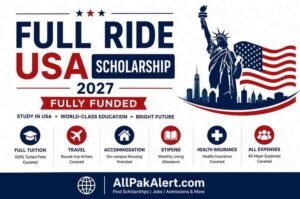
Full Ride USA Scholarships 2027 (Fully Funded)
Apply for Scholarships from Here.
A full ride USA scholarship covers 100% of a student’s costs, including tuition, housing, meals, and sometimes travel. For 2027, top fully funded options include the Fulbright Foreign Student Program, Berea College’s No-Tuition Promise, and Clark University’s Global Scholars Program, each with different eligibility rules and deadlines.
INTRODUCTION
Studying in the United States is a dream for millions of students, but the price tag can be intimidating. Tuition, housing, and living costs at American universities often run into tens of thousands of dollars a year. That’s exactly why full ride scholarships matter so much. A full ride scholarship doesn’t just help with fees — it wipes out the cost of your entire education, and in many cases your living expenses too.
This guide brings together the most reliable full ride USA scholarships open for the 2027 intake. You’ll find government-funded programs like Fulbright, university-run initiatives like Clark University’s Global Scholars Program, and unique no-tuition models like the one at Berea College. These opportunities are offered by the U.S. government and by individual universities, and they’re prestigious precisely because they’re so competitive and comprehensive in what they cover.
Eligibility varies by program, but most full ride USA scholarships are open to high-achieving undergraduate, graduate, or postgraduate students from anywhere in the world. If you have strong grades, leadership experience, and a clear sense of purpose, this guide will help you find the right program, understand what it funds, and map out exactly how to apply before the 2027 deadlines close.
QUICK OVERVIEW TABLE
| Scholarship | Host Institution | Degree Level | Coverage | Eligible Countries | Deadline (2027 cycle) |
|---|---|---|---|---|---|
| Fulbright Foreign Student Program | U.S. universities (varies) | Master’s, PhD | Tuition, stipend, airfare, health insurance | 155+ countries | Varies by country, roughly Feb–Oct 2026 |
| Berea College No-Tuition Promise | Berea College, Kentucky | Undergraduate | 100% tuition, room, board, fees (year one) | All countries | Around mid-December (check yearly) |
| Clark Global Scholars Program | Clark University, Massachusetts | Undergraduate | $15,000–$25,000/year for 4 years | All countries | Nov 1, 2026 or Jan 15, 2027 (admission deadline) |
| Rotary Peace Fellowship | Rotary Peace Centers (US-based) | Master’s, Certificate | Tuition, travel, living expenses | All countries | Varies — check Rotary district |
About the Full Ride USA Scholarships
Full ride scholarships in the USA generally come from three sources: the U.S. federal government, individual universities using their own endowments, and private foundations or civic organizations. Each has a different mission behind it.
Fulbright is the flagship U.S. government exchange program, run by the Bureau of Educational and Cultural Affairs together with local Fulbright Commissions and U.S. embassies in each country. It exists to build cultural understanding between the U.S. and the rest of the world, funding thousands of foreign students every year to pursue graduate study and research at American institutions.
University-run programs like Clark’s Global Scholars Program and Berea College’s No-Tuition Promise work differently. These are merit- and need-based awards funded through university endowments, aimed at building diverse, globally minded campuses. Berea is especially notable because it’s need-blind and tuition-free for every student, not just a handful of top scorers — making it one of the only true 100%-funded options for every enrolled international student.
Because these scholarships are highly sought after, competition is intense. Selection committees look beyond grades alone — leadership, community impact, and a compelling personal story often decide who gets the final offer.
SCHOLARSHIP BENEFITS
While the exact benefits differ by program, most full ride USA scholarships include a combination of the following:
✔ Full tuition coverage
✔ Monthly living stipend
✔ Round-trip airfare to and from the U.S.
✔ On-campus housing or a housing allowance
✔ Comprehensive health insurance
✔ Visa application support and guidance
✔ Book and course material allowances
✔ Mentorship and dedicated advisor support
✔ Access to alumni and professional networks
✔ Community service or leadership development opportunities
Government-funded programs like Fulbright tend to add research or professional development funding, while university scholarships like Clark’s often include a personal mentor for all four years of study.
AVAILABLE PROGRAMS
Full ride opportunities in the USA span nearly every level of study:
- Undergraduate (Bachelor’s): Berea College, Clark University Global Scholars Program
- Master’s: Fulbright Foreign Student Program, Rotary Peace Fellowship
- PhD and Research: Fulbright (select fields), university-specific doctoral fellowships
- Exchange and Short Courses: Rotary Peace Certificate program, various university exchange tracks
Most programs accept applicants across a wide range of majors, though Fulbright excludes clinical medicine and patient-contact research, and some university scholarships favor students in the humanities, sciences, or leadership-focused fields.
ELIGIBILITY CRITERIA
General eligibility across full ride USA scholarships usually includes:
- Applicants must not be U.S. citizens or permanent residents (for international-student-specific tracks)
- A strong academic record, typically a GPA equivalent to 3.5 or higher
- English proficiency, shown through IELTS, TOEFL, PTE, or Duolingo scores (though some programs, like Berea, accept alternatives)
- A completed or nearly completed secondary or undergraduate degree, depending on the program
- For Fulbright specifically: a bachelor’s degree completed before the grant start date, and no more than one prior Fulbright grant
- For Berea College: demonstrated significant financial need alongside academic merit
- For Clark University: first-year applicants who have studied outside the U.S. for at least four years
- Leadership experience, community involvement, or a clear research or study plan, depending on the award
Always check each program’s official page, since rules on age limits, subject restrictions, and nationality quotas can change from year to year.
REQUIRED DOCUMENTS
Across these scholarships, you’ll typically need:
- Valid passport
- Academic transcripts and degree certificates
- CV or resume
- Two to three recommendation letters
- Statement of purpose or motivation letter
- Study or research proposal (for Fulbright and similar research-based awards)
- English proficiency test scores
- Passport-sized photo
- Financial need documentation (for need-based programs like Berea)
- Any program-specific forms, such as the Fulbright online application or the Common Application essay for Clark
APPLICATION PROCESS
Step 1: Research your options. Compare programs by degree level, field of study, and country eligibility before you commit time to any single application.
Step 2: Check your eligibility. Read the official eligibility page for each scholarship carefully — small details, like citizenship status or years spent studying abroad, can disqualify you.
Step 3: Prepare your documents early. Transcripts, recommendation letters, and English test scores can take weeks to arrange, so start well before the deadline.
Step 4: Write a strong personal statement or proposal. This is often the single biggest factor in selection. Be specific about your goals and why the program fits them.
Step 5: Submit your application through the official portal. Fulbright applicants typically apply through their home country’s Fulbright Commission or U.S. Embassy; university scholarships are usually applied for through the Common Application or the university’s own portal.
Step 6: Prepare for interviews. Many full ride programs, including Fulbright, include an interview stage as part of final selection.
IMPORTANT DATES
| Stage | Fulbright | Berea College | Clark University |
|---|---|---|---|
| Applications Open | Varies (often Feb) | Around September | Rolling with admissions |
| Deadline | Varies by country (Feb–Oct 2026) | Mid-December 2026 | Nov 1, 2026 / Jan 15, 2027 |
| Interviews | Nov–Dec 2026 | N/A | N/A |
| Results | Early-mid 2027 | Spring 2027 | Spring 2027 |
| Classes Start | Fall 2027 | Fall 2027 | Fall 2027 |
IMPORTANT LINKS
- Fulbright Foreign Student Program: check your local U.S. Embassy or Fulbright Commission website
- Fulbright U.S. Student Program portal: us.fulbrightonline.org
- Berea College international admissions: berea.edu
- Clark University Global Scholars Program: clarku.edu
SELECTION PROCESS
- Initial screening — applications are checked for completeness and basic eligibility.
- Committee review — a panel evaluates academics, essays, and recommendation letters.
- Interview — shortlisted candidates are interviewed, often in English.
- Document verification — final checks on transcripts, test scores, and financial documents.
- Final selection and award — successful applicants receive an official offer letter detailing their funding package.
How to increase your chances for Full Ride USA Scholarships
- Write a focused, specific statement of purpose rather than a generic one
- Ask for recommendation letters from people who know your work well, not just senior titles
- Highlight leadership roles, volunteering, or community projects
- Take English tests early so you have time to retake them if needed
- Apply to more than one program to widen your chances
- Follow instructions exactly — missing a required document is one of the most common rejection reasons
COMMON MISTAKES TO AVOID
- Submitting applications after the deadline
- Uploading documents in the wrong file format
- Writing a generic essay that doesn’t mention the specific program
- Using an expired passport for identity verification
- Forgetting to check nationality-specific rules before applying
- Skipping required signatures or certifications on forms
LIVING IN THE USA
Living costs vary widely depending on the city and state. On average, international students should budget $1,000–$2,000 per month for accommodation, food, and transport outside major cities, and considerably more in places like New York or Boston. Many full ride scholarships, including Fulbright and Berea’s program, factor a living stipend or on-campus housing into the award specifically to offset these costs. Part-time, on-campus work is often allowed for F-1 visa holders, and most university towns offer active international student communities, health services, and safe, walkable campuses.
VISA INFORMATION
Most full ride scholarship recipients enter the U.S. on an F-1 student visa (or a J-1 exchange visitor visa for Fulbright grantees). After receiving your I-20 or DS-2019 form from your host institution, you’ll pay the SEVIS fee, complete the DS-160 form, and attend a visa interview at a U.S. embassy or consulate. Processing times vary but often take several weeks, so it’s important to apply as soon as your funding is confirmed. F-1 visa holders can generally work up to 20 hours per week on campus during the academic year.
WHY STUDY IN THE USA
- Home to many of the world’s top-ranked universities
- Wide range of majors, minors, and interdisciplinary programs
- Strong research funding and lab facilities
- Access to internships and Optional Practical Training (OPT) after graduation
- Large, diverse international student community
- Strong alumni networks across nearly every industry
FREQUENTLY ASKED QUESTIONS
Is a full ride scholarship the same as a full ride USA scholarship? Yes — the terms are used interchangeably to describe funding that covers all major costs of study.
Are these scholarships really fully funded? Most cover tuition plus a combination of housing, stipend, and travel, though the exact package differs by program.
Can European students apply? Yes, most of these programs, including Fulbright and Berea, are open to applicants from Europe.
Can African students apply? Yes, African applicants are eligible for all the programs listed here.
Can Asian students apply? Yes, Asian nationals are eligible, subject to each program’s country-specific rules.
Can Pakistani students apply? Yes, Pakistani students can apply through their local Fulbright Commission or directly to university programs like Berea and Clark.
Can Indian students apply? Yes, Indian students are eligible for Fulbright, Berea, and Clark, among others.
Can American citizens apply? No — these specific programs are designed for non-U.S. citizens; U.S. students should look at the separate Fulbright U.S. Student Program instead.
Is IELTS mandatory? Not always. Some programs accept TOEFL, PTE, Duolingo, or waive the requirement if your prior education was in English.
Is there an application fee? Most of these programs do not charge an application fee, though university admission fees may apply separately.
Can married students apply? Yes, in most cases, though dependent support varies by program.
Can I bring my family? Some programs allow dependents on a J-2 or F-2 visa, but funding for dependents is limited or unavailable.
What GPA is required? Most competitive applicants have a GPA equivalent to 3.5 or higher, though holistic review means it’s not the only factor.
Can I work while studying? Yes, F-1 visa holders can typically work up to 20 hours per week on campus.
How many students are selected each year? This varies widely — Fulbright funds around 4,000 foreign students globally each year, while Berea admits about 30 international students annually.
Can I apply for multiple programs at once? Yes, applying to more than one scholarship is allowed and often recommended.
Does age matter? Most programs don’t have strict age limits, but some prefer recent graduates.
What happens after I’m selected? You’ll receive an official award letter, followed by visa processing and pre-departure orientation.
How competitive is this scholarship? Very. Acceptance rates for programs like Berea’s international track are often in the 10–15% range.
Can I apply with a pending degree? Yes, many programs accept applicants who will complete their degree before the program starts.
What expenses are not usually covered? Personal travel, entertainment, and in some cases dependent costs are usually excluded.
Can I defer my scholarship? Deferral policies vary by program — some allow one-year deferrals, others do not.
Can I apply if I already hold another scholarship? Generally yes, but you must disclose it, and some programs may adjust your funding package accordingly.
How will I know if I’ve been selected? Successful applicants are typically notified by email, followed by an official award letter.
FINAL SUMMARY
Full ride USA scholarships for 2027 open the door to some of the world’s best universities without the financial burden that usually comes with them. Whether you’re drawn to the government-backed prestige of Fulbright, the guaranteed no-tuition model at Berea College, or the mentorship-driven Clark Global Scholars Program, there’s a path here worth pursuing if you start early and prepare carefully. Review each program’s official deadline, gather your documents well in advance, and don’t be afraid to apply to more than one — competitive as they are, every year thousands of international students win these awards and go on to build their future in the United States.