
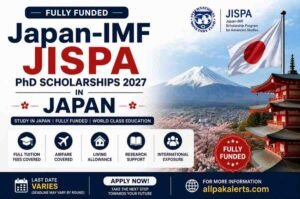
Japan-IMF JISPA PhD Scholarships 2027 in Japan
Apply for Scholarships from Here.
The Japan-IMF Scholarship Program for Asia (JISPA) PhD Track offers fully funded doctoral study at any university in Japan for junior government officials from 21 Asia-Pacific countries. Funded by the Government of Japan and administered by the IMF, it covers tuition, a monthly stipend, travel, and research-related expenses for up to three consecutive one-year periods.
INTRODUCTION
Are you a junior government official in Asia looking to sharpen your macroeconomic expertise with a doctoral degree in Japan? The Japan-IMF Scholarship Program for Asia (JISPA) PhD Track could be exactly the opportunity you’ve been looking for.
JISPA was established in 1993, funded by the Government of Japan, and administered by the IMF Regional Office for Asia and the Pacific (OAP). For more than three decades, it has supported junior officials from key economic agencies across the Asia-Pacific region, building a network of over 1,000 alumni — many of whom now serve as governors, vice ministers, and other senior policymakers in their home countries.
While JISPA’s flagship offering is its Master’s Track at four partner universities, the PhD Track works differently: it allows scholars to pursue doctoral studies at any university in Japan, rather than being limited to a fixed list of partner institutions. This gives PhD applicants far more flexibility to choose a university and supervisor that matches their specific research interests in economics and public policy.
Because this scholarship is aimed squarely at working government officials rather than fresh graduates, applicants need to combine strong academic credentials with real public-sector experience and, critically, formal nomination and sponsorship from their government agency. This guide walks you through everything you need to know about the JISPA PhD Scholarship 2027 — use the Table of Contents to jump to what matters most to you.
TABLE OF CONTENTS
- Quick Overview Table
- About the Scholarship
- Scholarship Benefits
- Available Programs
- Eligibility Criteria
- Required Documents
- Application Process
- Important Dates
- Important Links
- Selection Process
- How to Increase Your Chances
- Common Mistakes to Avoid
- Living in Japan
- Visa Information
- Why Study in Japan
- FAQs
- Final Summary
QUICK OVERVIEW TABLE
| Item | Details |
|---|---|
| Scholarship Name | Japan-IMF Scholarship Program for Asia (JISPA) — PhD Track |
| Host Country | Japan |
| Host University | Any university in Japan (your choice, subject to admission) |
| Degree Level | PhD (Doctoral) |
| Funded By | Government of Japan, administered by the IMF Regional Office for Asia and the Pacific (OAP) |
| Scholarship Type | Fully Funded |
| Coverage | Tuition, monthly stipend, travel, health insurance, research-related expenses |
| Eligible Countries | 21 Asia-Pacific countries (see Eligibility section) |
| Application Deadline | Varies by cycle; check the official JISPA page for current-year dates |
| Study Mode | Full-time, on-campus doctoral research |
| Duration | Up to 3 consecutive one-year periods (renewed annually) |
| IELTS Required | Not strictly mandatory, but a TOEFL or IELTS score is encouraged and strengthens your application |
| Application Fee | No separate JISPA scholarship fee |
About the Japan-IMF JISPA PhD Scholarships
JISPA occupies a distinctive niche among scholarships: it’s not aimed at students in general, but specifically at junior government officials working in economics-related departments across Asia and the Pacific. The program’s mission is to strengthen macroeconomic management and policy capacity in the region by giving promising officials advanced training in Japan, then sending them back to apply what they’ve learned.
The PhD Track is the more flexible of JISPA’s two study paths. Unlike the Master’s Track, which channels scholars into one of four specific partner universities — the National Graduate Institute for Policy Studies (GRIPS), Hitotsubashi University, the International University of Japan (IUJ), and the University of Tokyo — the PhD Track lets scholars apply to virtually any Japanese university, provided they secure admission on their own merit.
Because scholars are IMF-nominated government officials rather than typical international students, the review process weighs your professional trajectory as heavily as your academic record. Successful PhD applicants typically already hold a strong analytical background in economics, plus a track record of public-sector work that shows they’re positioned to bring real value back to their agency after graduation.
Scholars are renewed annually for up to three one-year periods, subject to the IMF’s approval, the host university’s assessment of academic progress, and the sponsoring government agency’s continued consent — meaning your performance and your agency’s support both matter throughout the programme, not just at the application stage.
Benifits of Japan-IMF JISPA PhD Scholarships
The JISPA PhD Track is a genuinely fully funded scholarship. It includes:
✔ Tuition Fees — Full coverage of your doctoral tuition at your chosen Japanese university.
✔ Monthly Stipend — A living allowance disbursed through your host university for the duration of your studies.
✔ Travel Support — Coverage of travel costs associated with beginning and completing your studies in Japan.
✔ Health Insurance — Coverage for your time in Japan as a scholar.
✔ Research-Related Expenses — Support for costs tied directly to your doctoral research.
✔ Access to JISPA’s Professional Network — Seminars, townhall meetings with IMF Management, policy dialogues, networking receptions with IMF staff and Japanese policymakers, and field trips to Japanese industries and government offices.
✔ Alumni Community — Lifetime access to a network of over 1,000 JISPA alumni, many in senior policymaking roles across the region.
Note that JISPA does not cover expenses for accompanying family members, and scholars are not permitted to accept any other scholarship while receiving JISPA funding.
AVAILABLE PROGRAMS
The PhD Track supports doctoral study at any Japanese university, in fields directly relevant to macroeconomic policy and public administration, including:
- Economics
- Public Policy
- Public Administration
- Finance and Monetary Policy
- Development Economics
Unlike the Master’s Track’s four fixed partner universities, PhD applicants are free to target the specific Japanese university and supervisor best suited to their research interests, as long as they can secure independent admission to that university’s doctoral programme.
ELIGIBILITY CRITERIA
To apply for the JISPA PhD Scholarship 2027, you generally need to:
- Be a national of one of the 21 JISPA-eligible countries: Bangladesh, Bhutan, Cambodia, India, Indonesia, Kazakhstan, Kyrgyz Republic, Lao P.D.R., Malaysia, Maldives, Mongolia, Nepal, Pacific Island Countries, Papua New Guinea, Philippines, Sri Lanka, Tajikistan, Thailand, Timor-Leste, Turkmenistan, Uzbekistan, and Vietnam
- Be a junior government official working in an economics-related government department or agency
- Be nominated and sponsored by your government agency
- Hold a bachelor’s degree (equivalent to at least 16 years of formal education)
- Have at least 2 years of work experience in the public sector at the time of application
- Be under 36 years old at the time of application (a priority criterion)
- Not have already obtained a Master’s degree from outside your own country (a priority criterion)
- Be prepared to devote full-time effort to your studies while in Japan
- Not be receiving any other scholarship during your JISPA award period
Applicants are encouraged, though not strictly required, to submit a TOEFL or IELTS score as part of their application, which can strengthen your candidacy.
REQUIRED DOCUMENTS
To apply, you’ll typically need:
- Completed JISPA scholarship application form
- Official nomination and sponsorship letter from your government agency
- Bachelor’s degree certificate and academic transcripts
- Proof of at least 2 years of public-sector work experience
- CV/Resume detailing your government role and responsibilities
- Statement of purpose or research proposal outlining your intended PhD research
- Letters of recommendation (academic and/or professional)
-
TOEFL or IELTS score report, if available (register the JISPA institution code when taking the test: TOEFL code
“C626 – Japan-IMF Scholarship Program for Asia”; IELTS code “JISPA: Japan-IMF Scholarship Program for Asia”)
- Proof of separate admission (or application) to your target Japanese university’s doctoral programme
APPLICATION PROCESS
Step 1: Confirm your eligibility and secure agency nomination. Since JISPA requires official nomination, start by confirming your government agency’s willingness to sponsor your application.
Step 2: Identify your target Japanese university and doctoral programme. Unlike the Master’s Track, the PhD Track lets you choose from any Japanese university — research institutions and supervisors that align with your policy research interests.
Step 3: Apply for admission to your chosen university. Submit a separate application directly to your target university’s graduate school for doctoral admission — this process runs independently of your JISPA scholarship application.
Step 4: Prepare your JISPA scholarship application. Gather your nomination letter, transcripts, CV, research proposal, and recommendation letters for the JISPA application itself.
Step 5: Submit your TOEFL or IELTS score, if available. While not always mandatory, submitting a score using the correct JISPA institution code can strengthen your file.
Step 6: Submit your complete JISPA application. Follow the current application instructions on the official JISPA page, since submission channels can vary by application cycle.
Step 7: Await review and selection. Applications are reviewed by the IMF Regional Office for Asia and the Pacific, weighing your academic background, government nomination, and research proposal.
Step 8: Confirm your scholarship and university admission together. Your JISPA award and your university admission are two separate approvals — you’ll need both confirmed before enrolling.
IMPORTANT DATES
| Milestone | Timing |
|---|---|
| Application Window | Typically opens several months before the academic year begins; exact dates vary by cycle |
| Application Deadline | Check the official JISPA page for the current cycle’s confirmed deadline |
| Selection and Notification | Following the application review period |
| Academic Year Begins | April intake is common at Japanese universities, though this varies by institution |
Since JISPA’s PhD Track application cycle and deadlines are announced separately from the Master’s Track’s published brochure, always confirm the current year’s exact dates directly on the official JISPA website before preparing your application.
IMPORTANT LINKS
- Official JISPA Home page: imf.org/en/countries/resrep/oap-home/jispa-home
- What is JISPA (programme overview): imf.org/en/countries/resrep/oap-home/jispa-home/what-is-jispa
- IMF Regional Office for Asia and the Pacific: imf.org/en/countries/resrep/oap-home
- IMF Capacity Development: imf.org/en/capacity-development
SELECTION PROCESS
- Agency nomination — Your government agency formally nominates and sponsors your application.
- Application submission — You submit your JISPA application alongside your independent university admission application.
- Eligibility screening — The IMF Regional Office for Asia and the Pacific checks your nationality, work experience, and academic qualifications.
- Academic and research review — Your academic background, research proposal, and career trajectory are evaluated.
- Priority criteria assessment — Candidates under 36, without a foreign master’s degree, and with strong public-sector experience receive priority consideration.
- Final selection and university confirmation — Successful candidates receive both their JISPA award confirmation and their university admission decision.
- Annual renewal — Each subsequent year of PhD funding is reviewed and renewed based on academic progress, university assessment, and agency consent.
HOW TO INCREASE YOUR CHANCES
- Secure strong, genuine support and nomination from your government agency early in the process
- Choose a Japanese university and supervisor whose research strengths clearly match your intended PhD topic
- Write a focused, policy-relevant research proposal that connects to your government role
- Submit a TOEFL or IELTS score if you can, using the correct JISPA institution code
- Highlight concrete public-sector achievements and responsibilities in your CV
- Apply well before the deadline, since coordinating both a university admission and a scholarship nomination takes time
- Demonstrate a clear plan for how your doctoral research will benefit your agency and country after graduation
COMMON MISTAKES TO AVOID
- Applying without first securing your government agency’s nomination and sponsorship
- Treating the university admission process and the JISPA scholarship application as the same step (they are separate)
- Submitting a research proposal that isn’t clearly connected to macroeconomic policy or public administration
- Skipping the TOEFL/IELTS score entirely when you could strengthen your application by including one
- Assuming JISPA covers expenses for accompanying family members (it does not)
- Applying while already holding another scholarship, which isn’t permitted under JISPA rules
- Missing the specific deadline for the PhD Track, since it can differ from the Master’s Track’s published dates
LIVING IN JAPAN
- Cost of living: Japan’s cost of living varies significantly by city — Tokyo is considerably more expensive than smaller university towns
- Accommodation: University dormitories and private rentals near campus are common options for international scholars
- Food: A wide range of affordable dining options, from student cafeterias to convenience stores, alongside Japan’s broader culinary culture
- Transport: Japan’s public transport system is extensive, reliable, and well-connected between cities and campuses
- Weather: Distinct four seasons, with hot, humid summers and cold winters depending on the region
- Student life: Access to Japan’s strong academic and research culture, alongside JISPA’s dedicated scholar community and orientation programme
- Safety: Japan is widely regarded as one of the safest countries in the world for international students and researchers
VISA INFORMATION
- International doctoral students in Japan typically require a Student visa (Ryugaku)
- Your host university will generally issue a Certificate of Eligibility (CoE) to support your visa application once admission is confirmed
- You’ll need your CoE, passport, university acceptance letter, and JISPA scholarship confirmation as part of your visa application
- Processing times vary, so it’s best to begin the visa process as soon as both your university admission and JISPA award are confirmed
- JISPA scholars are expected to devote full-time effort to their studies, so visa conditions typically reflect a full-time student status rather than part-time work arrangements
Always confirm the latest visa requirements directly with the Japanese embassy or consulate in your home country, since immigration procedures can change.
WHY STUDY IN JAPAN
- Home to internationally respected universities with strong economics and public policy research
- A scholarship uniquely designed around real policymaking impact, not just academic achievement
- Access to IMF-level seminars, policy dialogues, and networking opportunities alongside your doctoral studies
- A safe, technologically advanced, and culturally rich environment for international scholars
- A genuinely pan-Asian professional network through JISPA’s 1,000+ alumni community
- Strong potential to directly influence economic policy back home after graduation, backed by a respected international credential
IMPORTANT FAQs
1. Is the JISPA PhD Scholarship fully funded? Yes. It covers tuition, a monthly stipend, travel, health insurance, and research-related expenses.
2. Who can apply? Junior government officials from 21 eligible Asia-Pacific countries, nominated and sponsored by their government agency.
3. Can European students apply? No, JISPA is limited to nationals of its 21 specifically eligible Asia-Pacific countries.
4. Can African students apply? No, this scholarship is restricted to nationals of the eligible Asia-Pacific countries listed in the eligibility criteria.
5. Can Asian students apply? Yes, but only from the 21 specifically eligible Asia-Pacific countries — not all Asian nationalities qualify.
6. Can Pakistani students apply? No, Pakistan is not currently listed among JISPA’s 21 eligible countries.
7. Can Indian students apply? Yes, India is one of JISPA’s eligible countries.
8. Can American students apply? No, JISPA is limited to nationals of its specifically eligible Asia-Pacific countries.
9. Is IELTS mandatory? Not strictly mandatory, but applicants are encouraged to submit a TOEFL or IELTS score to strengthen their application.
10. Can I apply without IELTS? Yes, it’s possible to apply without a formal IELTS score, though including one is generally advantageous.
11. Is there an application fee? There’s no separate JISPA scholarship application fee, though your target university may have its own admission fees.
12. Can married students apply? Yes, marital status doesn’t affect eligibility, though family members’ expenses are not covered by the scholarship.
13. Can I bring my family? You can, but JISPA does not cover any expenses for accompanying family members.
14. What academic background is required? A bachelor’s degree equivalent to at least 16 years of formal education, plus a strong analytical grounding in economics or a related field.
15. Can I work while studying? JISPA scholars are expected to devote full-time effort to their studies, so independent part-time work isn’t the intended focus of the programme.
16. How many PhD scholarships are awarded each year? The exact number varies by year and available government nominations; check the official JISPA page for current figures.
17. Can I apply for both the Master’s and PhD tracks? You apply for the specific track that matches your intended qualification; check with the JISPA office if you’re unsure which fits your background.
18. Is there an age limit? Being under 36 years old at the time of application is a stated priority criterion, though not necessarily an absolute cutoff — confirm current policy with JISPA directly.
19. What happens after I’m selected? You’ll need to finalize both your university admission and your JISPA scholarship confirmation before beginning your programme in Japan.
20. How competitive is this scholarship? Very competitive, since it combines a limited number of places with the added requirement of formal government nomination.
21. Can I apply with a degree still in progress? No, a completed bachelor’s degree is required at the time of application.
22. What expenses are not covered? Expenses for accompanying family members are not covered under any circumstances.
23. Can I defer my scholarship to a later year? Deferral isn’t a standard published feature; confirm directly with the JISPA office if your circumstances require it.
24. Can I apply if I already hold another scholarship? No, JISPA scholars are not permitted to accept any other scholarship during their award period.
25. How will I know if I’ve been selected? The IMF Regional Office for Asia and the Pacific will notify successful candidates and their sponsoring government agencies directly following the review process.
FINAL SUMMARY
The Japan-IMF JISPA PhD Scholarship 2027 offers a rare combination: a fully funded doctoral degree at any Japanese university, paired with direct access to IMF-level policy training and a powerful regional alumni network. It’s specifically built for junior government officials in economics-related roles who want to deepen their expertise and bring real policy impact back to their home countries.
Because eligibility depends on both your personal academic and professional qualifications and your government agency’s formal nomination, the strongest applications start with securing that institutional support early, well before you begin drafting your research proposal or applying to Japanese universities.
Check the official JISPA website for the confirmed application dates for the coming cycle, and start the nomination conversation with your agency as soon as possible.