
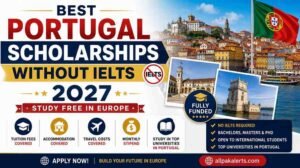
Best Portugal Scholarships Without IELTS 2027 (Study Free)
Apply for Scholarships from Here.
Several Portugal scholarships accept alternatives to IELTS in 2027, including Portuguese Government Scholarships (DGES, Camões, I.P., and FCT), University of Porto, University of Coimbra, and University of Aveiro merit scholarships, plus Erasmus Mundus joint master’s programmes hosted in Portugal. Most accept a Medium of Instruction (MOI) letter, a university’s own English test, or proof of prior English-medium education instead of a formal IELTS score.
INTRODUCTION
Want to study in Portugal without taking the IELTS exam? You’re not alone — and the good news is, it’s genuinely possible.
Portugal has become one of Europe’s most popular study destinations for international students, thanks to its relatively low tuition fees, affordable cost of living, warm climate, and a growing number of English-taught degree programmes. What many students don’t realize is that a large number of Portuguese universities and government-backed scholarships don’t insist on a formal IELTS certificate — they’ll accept alternatives instead.
Before you get too excited, here’s the honest catch: “no IELTS” almost never means “no proof of English at all.” Most of the scholarships on this list will still ask you to demonstrate English proficiency through one of these routes:
- A Medium of Instruction (MOI) letter from your previous school or university, confirming your last degree was taught in English
- The university’s own internal English test, taken during or after admission
- Proof of prior education in an English-speaking country or an English-medium curriculum
- A recognized Portuguese language certificate (B1 or B2 level), if you’re applying to a Portuguese-taught programme instead
This guide rounds up the most legitimate Portugal scholarships for 2027 that accept these IELTS alternatives, across government-funded, university-funded, and joint European programmes. Use the Table of Contents to jump to the section you need.
TABLE OF CONTENTS
- Quick Overview Table
- What “Without IELTS” Really Means
- Portuguese Government Scholarships
- University of Porto Scholarships
- University of Coimbra Merit Scholarships
- University of Aveiro Scholarships
- NOVA University Lisbon Scholarships
- Carnegie Mellon Portugal Program
- Coimbra Group Scholarships
- Erasmus Mundus Joint Master’s Programmes in Portugal
- Required Documents (General)
- How to Apply: General Steps
- How to Increase Your Chances
- Common Mistakes to Avoid
- Living in Portugal
- Visa Information
- Why Study in Portugal
- FAQs
- Final Summary
QUICK OVERVIEW TABLE
| Scholarship | Level | Funded By | English Proof Alternative |
|---|---|---|---|
| Portuguese Government Scholarships | Bachelor’s, Master’s, PhD | DGES, Camões I.P., FCT | MOI letter, prior English-medium study |
| University of Porto Scholarships | Bachelor’s, Master’s, PhD | University of Porto | English or Portuguese proficiency proof |
| University of Coimbra Merit Scholarships | Bachelor’s, Master’s | University of Coimbra | Admission-grade based; language proof by programme |
| University of Aveiro Scholarships | Bachelor’s, Master’s | University of Aveiro | Programme-dependent English proof |
| NOVA University Lisbon Scholarships | Master’s, PhD | NOVA University Lisbon | MOI letter often accepted |
| Carnegie Mellon Portugal Program | Master’s, PhD | Carnegie Mellon & Portuguese partner universities | Programme-dependent |
| Coimbra Group Scholarships | Bachelor’s, Master’s, PhD, Research | Coimbra Group universities | Varies by host university |
| Erasmus Mundus Joint Master’s (Portugal-hosted) | Master’s | European Union (EACEA) | MOI letter commonly accepted |
WHAT “WITHOUT IELTS” REALLY MEANS
Before diving into the list, it’s worth understanding how “no IELTS” scholarships actually work in Portugal.
Most Portuguese universities set their own English proficiency policy per programme, not per scholarship. That means the scholarship itself may not require IELTS, but your chosen degree programme might still expect some form of English proof — just not necessarily IELTS specifically. The most common accepted alternative is the Medium of Instruction (MOI) letter: a signed letter from your previous school confirming that your prior education was delivered in English.
If you don’t have an MOI letter and haven’t studied in English before, many Portuguese universities offer their own English placement test, sometimes free, as part of the admissions process. And if you’re open to a Portuguese-taught programme instead, a B1 or B2 Portuguese language certificate can replace the English requirement altogether.
The bottom line: always check the specific admission requirements of your target programme, not just the scholarship’s marketing page, before assuming you’re fully exempt from any English proof.
Portugal Scholarships
Portugal’s government-funded scholarships are managed primarily through three bodies: the Directorate-General for Higher Education (DGES), Camões, I.P. (the Institute for Cooperation and Language), and the Foundation for Science and Technology (FCT).
- DGES scholarships support bachelor’s, master’s, and PhD students, with application cycles typically opening in the spring for the following academic year.
- Camões, I.P. scholarships run bilateral cooperation programmes with many countries, with a particular focus on Portuguese-speaking countries (CPLP nations) and priority pipelines for developing nations.
- FCT scholarships primarily fund PhD and research-focused programmes.
Many of these government scholarships accept an MOI letter or proof of prior English-medium study in place of IELTS, particularly for programmes taught in English at partner universities. Applications are typically submitted through the DGES portal or directly to Camões, I.P., depending on the specific programme.
Best for: Students from Portuguese-speaking countries or developing nations seeking bachelor’s, master’s, or PhD funding.
UNIVERSITY OF PORTO SCHOLARSHIPS
The University of Porto (U.Porto) is one of Portugal’s most internationally recognized universities, offering several scholarship types for both domestic and international students:
- SASUP Scholarships — monthly cash payments to help cover course-related costs, primarily for Portuguese and EU nationals (excludes students with International Student Status)
- Merit Scholarships — awarded to U.Porto students with the best academic results, open to a broader pool of applicants
- Scientific Scholarships — for students and researchers involved in recognized scientific research projects
Across all scholarship types, U.Porto requires proof of proficiency in the language of instruction — either English or Portuguese, depending on your programme. Many master’s and doctoral programmes are taught in English, and the university generally accepts documented proof of prior English-medium education instead of insisting specifically on IELTS.
Best for: Students targeting Porto’s strong engineering, business, and science programmes who can document previous English-medium study.
UNIVERSITY OF COIMBRA MERIT SCHOLARSHIPS
Founded in 1290, the University of Coimbra is one of the oldest universities in the world, and it runs one of the more structured merit scholarship systems for international students:
- Merit Scholarships for Undergraduate Programmes — around 200 scholarships available, worth €1,000–€2,000, for students with an admission score of 160 points or higher (on Coimbra’s grading scale)
- Extraordinary Merit Scholarship — a full tuition fee exemption for students with an admission grade of 180 points or above who can demonstrate financial need
- Strategic Support Scholarship — €2,000 in the first year for students admitted into specific priority study areas, announced annually
- Master’s Programme Tuition Exemption — a €2,000 tuition fee exemption for eligible international master’s students, continuing throughout the programme
Coimbra’s scholarships are largely grade-based rather than English-test-based, and international students who qualify through recognized entrance exams (such as A-Levels, the International Baccalaureate, or equivalent) may not need a separate IELTS score, depending on their programme’s specific language policy. (Best Portugal Scholarships)
Best for: High-achieving students with strong grades from internationally recognized qualifications.(Best Portugal Scholarships)
UNIVERSITY OF AVEIRO SCHOLARSHIPS
The University of Aveiro (UA) is Portugal’s largest public research-focused institution, offering merit-based scholarships to eligible international students who meet its admission requirements. Award amounts and eligibility criteria vary by programme and are published annually, so applicants should check the specific call for their intended degree.
Language requirements at Aveiro follow the same general pattern as other Portuguese universities: proof of English proficiency is programme-dependent, and MOI letters or the university’s own placement assessment are commonly accepted alternatives to IELTS.
Best for: Students interested in Aveiro’s research-strong science and engineering programmes.
NOVA UNIVERSITY LISBON SCHOLARSHIPS
NOVA University Lisbon is known for its international outlook and a wide range of English-taught master’s and PhD programmes, particularly in fields like international relations, business, and law. NOVA runs various excellence and merit-based scholarships for international students, and several English-taught programmes accept an MOI letter as an alternative to a formal IELTS certificate, particularly for applicants who completed their previous degree in English.
Best for: Students pursuing English-taught postgraduate degrees in social sciences, business, or law.
CARNEGIE MELLON PORTUGAL PROGRAM
The Carnegie Mellon Portugal Program is a partnership between Carnegie Mellon University (USA) and a consortium of Portuguese universities, offering dual-degree PhD and professional master’s programmes, along with research and faculty exchange opportunities. Around a dozen scholarships are offered yearly, open to both domestic and international students, with a strong focus on technology, innovation, and commercializable research.
Because this is a binational, English-taught programme by design, admission generally emphasizes your technical and academic background, with English proficiency requirements that can often be met through prior English-medium study rather than a mandatory IELTS score — though this should always be confirmed directly with the programme.
Best for: Students pursuing advanced technology, engineering, or innovation-focused PhD and master’s research.
COIMBRA GROUP SCHOLARSHIPS
The Coimbra Group is a network of long-established European universities, including the University of Coimbra, that runs its own scholarship programmes for international students and young researchers, such as:
- Scholarship Programme for Young Researchers from Sub-Saharan Africa
- Scholarship Programme for Young Researchers from European Neighbouring Countries
These programmes typically cover a research fund and accommodation allowance, and are open to researchers affiliated with Coimbra Group member universities, including Coimbra itself. Language and documentation requirements vary by host university and specific call, so always check the current edition’s rules before applying.
Best for: Early-career researchers from Africa or Europe’s neighbouring countries seeking a short research stay in Portugal.
ERASMUS MUNDUS JOINT MASTER’S PROGRAMMES IN PORTUGAL
Several EU-funded Erasmus Mundus Joint Master Degree (EMJMD) programmes include Portuguese universities as consortium partners. These fully funded, EU-backed master’s programmes typically span multiple European countries, including a semester or more in Portugal, and are known for being relatively flexible on English proof — most accept an MOI letter as a substitute for IELTS, since the programmes are inherently international and taught entirely in English regardless of the host country.
Because Erasmus Mundus programmes change their exact list of partner universities and countries from cohort to cohort, always check the specific programme’s current consortium and requirements on the official EACEA or programme website before applying.
Best for: Students who want a genuinely pan-European master’s experience with Portugal as one of several host countries.
REQUIRED DOCUMENTS (GENERAL)
While each scholarship above has its own specific checklist, most Portugal scholarship applications will ask for:
- Valid passport or national ID
- Academic transcripts and degree certificates
- Proof of admission or acceptance to your chosen Portuguese university programme
- CV/Resume
- Motivation letter or Statement of Purpose
- Letters of recommendation
- Medium of Instruction (MOI) letter, or another accepted proof of English proficiency
- Proof of financial need (for need-based awards)
- Passport-sized photograph
HOW TO APPLY: GENERAL STEPS
Step 1: Choose your university and programme. Decide whether you want a Portuguese public university (like Porto, Coimbra, Aveiro, or NOVA), a binational programme (like Carnegie Mellon Portugal), or a multi-country Erasmus Mundus degree.
Step 2: Check the specific English proficiency policy for your programme. Confirm directly with the university whether an MOI letter, internal test, or Portuguese-language alternative is accepted in place of IELTS.
Step 3: Apply for admission to your chosen programme. Submit your university application first, since most scholarships (like Coimbra’s and Porto’s) are tied to your admission or academic record.
Step 4: Apply for the relevant scholarship separately, if required. Some scholarships (like U.Porto’s Merit and Scientific Scholarships) require a distinct scholarship application in addition to your programme application.
Step 5: Gather your required documents. Prepare transcripts, your MOI letter or English proof, CV, and any required letters of recommendation or motivation statements.
Step 6: Submit before the deadline. Deadlines vary significantly by scholarship and university — some open as early as May for the following academic year, so start early.
Step 7: Track your application and respond to any follow-up requests. Some scholarships may follow up with an internal English test or additional document requests, so check your email and portal regularly.
HOW TO INCREASE YOUR CHANCES
- Start collecting your MOI letter or other English proof documentation early, since it can take time to get signed and certified
- Apply to more than one Portuguese university, since scholarship rules and English proof requirements vary
- If your grades qualify, prioritize grade-based scholarships (like Coimbra’s Merit Scholarship), which don’t hinge as heavily on English test requirements
- Consider Portuguese-taught programmes if you already have B1/B2 Portuguese proficiency — this sidesteps the English requirement entirely
- Apply well ahead of each scholarship’s specific deadline, since some government scholarships open as early as spring
- Double check whether your scholarship of interest requires a separate scholarship application, in addition to your university application
COMMON MISTAKES TO AVOID
- Assuming “no IELTS” means no English proof is needed at all
- Missing your target university’s own internal English test window
- Applying for a scholarship without first securing admission to an eligible programme
- Not checking whether your MOI letter meets the university’s specific format requirements
- Confusing government scholarship deadlines (which vary by year) with university-specific scholarship deadlines
- Overlooking Portuguese-taught programme options if your English proof is incomplete
LIVING IN PORTUGAL
- Cost of living: Around €500–€800 per month covers accommodation, food, transport, and other daily expenses in most Portuguese cities
- Tuition costs: International student tuition generally ranges from €1,000 to €7,000 per year at public universities, though this varies significantly by programme and institution
- Accommodation: University residences and private rentals are both common; student housing is more affordable in cities like Coimbra and Aveiro compared to Lisbon
- Food: Portuguese cuisine is generally affordable, with student-friendly cafés and canteens near most campuses
- Transport: Reliable public transport in major cities, plus discounted student passes
- Weather: A mild Mediterranean climate with warm summers and mild winters
- Student life: A growing international student community, particularly in Lisbon, Porto, and Coimbra
- Safety: Portugal is consistently ranked among the safer countries in Europe
VISA INFORMATION
- Non-EU/EEA students will typically need a Portuguese student visa/residence permit to study in Portugal
- After receiving your university admission and scholarship confirmation, you’ll need proof of acceptance, financial means, and accommodation arrangements for your visa application
- International students holding a valid student residence permit are generally permitted to work part-time (up to 20 hours per week during term time, and full-time during holidays) under Portuguese immigration rules
- Processing times vary by country, so apply for your visa as soon as your admission and scholarship are confirmed
Always check the latest visa requirements directly through the Portuguese consulate or embassy in your country, since rules can change.
WHY STUDY IN PORTUGAL
- Lower tuition and living costs compared to many other Western European study destinations
- A growing number of English-taught bachelor’s, master’s, and PhD programmes
- Warm climate and a relaxed, welcoming culture
- Strong research partnerships, including binational programmes like Carnegie Mellon Portugal
- Access to the wider European job market and Erasmus+ mobility opportunities
- A safe, historically rich environment with centuries-old universities alongside modern research institutions
Portuguese Government Scholarships
- DGES (Directorate-General for Higher Education): dges.gov.pt
- Camões, I.P. — Scholarships page: instituto-camoes.pt/en/activity-camoes/what-we-do/scholarships
- Camões, I.P. — Government Scholarships & Foreign Institutions: instituto-camoes.pt/en/activity-camoes/what-we-do/scholarships/government-scholarships-and-foreign-institutions
- FCT (Foundation for Science and Technology): fct.pt
University Scholarships
- University of Porto — Scholarships and Funding: up.pt/portal/en/live/student-life/scholarships-and-funding
- University of Coimbra — Financial Support for International Applicants: uc.pt/international-applicants/oportunidades/funding/ei
- University of Coimbra — Merit Scholarships regulation page: uc.pt/en/academicos/premios_bolsas/bolsas_estudos_graduados
- University of Aveiro: ua.pt
- NOVA University Lisbon: unl.pt
Other Programmes
- Carnegie Mellon Portugal Program: cmuportugal.org
- Coimbra Group (scholarships): coimbra-group.eu
- Erasmus Mundus Joint Master Degrees catalogue (EACEA): erasmus-plus.ec.europa.eu/opportunities/opportunities-for-individuals/students/erasmus-mundus-joint-masters
IMPORTANT FAQs
1. Can I really study in Portugal without IELTS? Yes, many Portuguese universities and scholarships accept alternatives like an MOI letter, their own English test, or prior English-medium education instead of IELTS.
2. Are these scholarships fully funded? It depends — some, like certain Camões, I.P. and Erasmus Mundus awards, are fully funded, while others (like most Porto and Coimbra merit scholarships) are partial tuition exemptions or stipends.
3. Who can apply for Portugal scholarships without IELTS? Eligibility varies by scholarship — some target specific regions (like Camões’ focus on Portuguese-speaking countries), while others are open globally.
4. Can African students apply? Yes, several options — including Camões, I.P. scholarships and the Coimbra Group’s Sub-Saharan Africa programme — specifically prioritize African applicants.
5. Can Asian students apply? Yes, most university-based scholarships (Porto, Coimbra, Aveiro, NOVA) are open to students from any country, including Asia.
6. Can Pakistani students apply? Yes, Pakistani students are generally eligible for university-based and Erasmus Mundus scholarships in Portugal.
7. Can Indian students apply? Yes, Indian students are generally eligible, particularly for merit-based university scholarships and Erasmus Mundus programmes.
8. Can American students apply? Yes, and US students specifically may also want to look at Gilman Scholarship-linked opportunities for study in Portugal, in addition to standard university scholarships.
9. Is IELTS completely unnecessary for these scholarships? Not entirely — you’ll usually still need to prove English proficiency some other way, such as an MOI letter or a university’s internal test.
10. What is an MOI letter? A Medium of Instruction letter is a signed document from your previous school confirming that your degree was taught in English, often accepted instead of a formal English test score.
11. Is there an application fee? Most government and university scholarships in Portugal don’t charge a separate scholarship fee, though standard university application fees may apply.
12. Can married students apply? Yes, marital status doesn’t generally affect eligibility for these scholarships.
13. Can I bring my family? This depends on your specific visa category and scholarship; check with the relevant Portuguese consulate and your host university.
14. What GPA is required? This varies by scholarship — Coimbra’s Merit Scholarship, for example, requires an admission score of at least 160 points on its own grading scale.
15. Can I work while studying? Yes, international students on a valid residence permit can generally work part-time during term and full-time during holidays.
16. How many scholarships are available in Portugal each year? This varies widely by institution and government programme; each university publishes its own annual scholarship call with specific quotas.
17. Can I apply for multiple Portugal scholarships at once? Yes, in most cases, though some institutions may require you to choose one if you’re selected for more than one.
18. Is there an age limit? Age limits aren’t commonly stated for most Portugal university scholarships, though some government or bilateral programmes may set their own conditions.
19. What happens after I’m selected? You’ll typically receive confirmation from your host university or Camões, I.P., followed by guidance on enrollment and visa steps.
20. How competitive are these scholarships? Competitiveness varies — merit scholarships tied to admission grades can be quite selective (acceptance rates around 10–25% at some universities), while broader government programmes vary by country quota.
21. Can I apply with a degree still in progress? This depends on the specific scholarship; some require a completed qualification, while others accept conditional admission.
22. What expenses are not covered? Partial scholarships, like most university merit awards, typically don’t cover full living costs, travel, or health insurance — check each scholarship’s specific coverage.
23. Can I defer my scholarship to a later year? Deferral policies vary by scholarship and university; confirm directly with the awarding institution.
24. Can I apply if I already hold another scholarship? This depends on the specific scholarship’s rules; some may restrict combining multiple funding sources.
25. How will I know if I’ve been selected? Notification methods vary — university-based scholarships typically confirm through your applicant portal or admissions office, while government scholarships notify through Camões, I.P. or DGES directly.
FINAL SUMMARY
Studying in Portugal without IELTS in 2027 is a realistic goal, not a rare exception — as long as you understand the nuance behind the “no IELTS” label. From government-backed Camões and DGES scholarships to university merit awards at Porto, Coimbra, Aveiro, and NOVA, and multi-country Erasmus Mundus degrees, there are multiple funded pathways that accept an MOI letter or alternative English proof instead of a formal IELTS score.
The key is to check the specific requirements of your target programme early, gather your documentation well in advance, and apply broadly across several of these options rather than relying on just one.
Official Link
https://www.dges.gov.pt