
Erasmus Mundus MAPP Scholarship 2027 (Fully Funded)
Apply for Scholarships from Here.
The Erasmus Mundus MAPP Scholarship 2027 is a fully funded two-year Master’s in Public Policy delivered by a consortium of four European universities. It covers full tuition, a €1,400 monthly stipend, health insurance, and travel support for students from anywhere in the world, EU or non-EU.
Introduction
Looking for a scholarship that lets you earn a master’s degree while living and studying in multiple European countries — all without paying tuition? The Erasmus Mundus MAPP Scholarship 2027 might be exactly what you’re after. Funded by the European Union’s Erasmus+ program, Mundus MAPP (Master’s in Public Policy) is one of the most respected joint master’s programs in Europe, delivered by a consortium of four leading universities: Central European University (Austria), the International Institute of Social Studies (Netherlands), IBEI (Spain), and the University of York (UK).
This two-year program is designed for students who want to dig into public policy, governance, development, and political economy — and who don’t mind moving between countries to do it. In fact, mobility is built into the program: every scholar studies at two different institutions in two different countries as part of their degree.
The scholarship itself is generous. Fully funded scholars receive complete tuition coverage, a monthly living stipend, health insurance, and contributions toward travel and relocation costs. It’s open to applicants from anywhere in the world — EU and non-EU citizens alike — making it a genuinely global opportunity for students from Europe, Asia, Africa, the Middle East, the Americas, and Oceania. If you have a strong bachelor’s degree in a relevant field and a passion for policy work, this guide walks you through everything you need to apply.
Quick Overview Table
| Item | Details |
|---|---|
| Scholarship Name | Erasmus Mundus MAPP Scholarship (Master’s in Public Policy) |
| Host Country | Austria, Netherlands, Spain, United Kingdom (choose a mobility track) |
| Host University | Central European University, ISS Erasmus University Rotterdam, IBEI, University of York |
| Degree Level | Master’s (2-year joint degree) |
| Funded By | European Union (Erasmus+ Programme) |
| Scholarship Type | Fully funded (with a partial/institutional option) |
| Coverage | Full tuition, monthly stipend, health insurance, travel/relocation support |
| Eligible Countries | Open worldwide — EU and non-EU applicants |
| Application Deadline | Scholarship deadline typically around December 1, 2026 (confirm on official calendar once published) |
| Study Mode | Full-time, on-campus, mandatory mobility across 2 countries |
| Duration | 2 years |
| IELTS Required | Yes, unless exempt (native speaker or prior degree taught in English) |
| Application Fee | None mentioned by the consortium |
About the Erasmus Mundus MAPP Scholarship
Mundus MAPP has been running since 2007 and has built a strong reputation as one of Europe’s leading joint master’s degrees in public policy. It’s coordinated centrally through Central European University (CEU) in Vienna, but a joint academic committee across all four consortium universities reviews every application together, so your file gets evaluated from multiple institutional perspectives at once.
What sets this scholarship apart is the built-in international mobility. Instead of studying at just one university, every scholar spends time at two different institutions in two different countries, chosen based on their specialization track. This isn’t optional — it’s a core part of how the degree is structured, and it means graduates leave with firsthand experience navigating different academic systems, cultures, and professional networks across Europe.
Because it’s funded through the EU’s Erasmus+ program, the scholarship is considered one of the most prestigious and well-resourced joint degree funding schemes available to international students, and competition for the fully funded slots is strong every year.
Scholarship Benefits
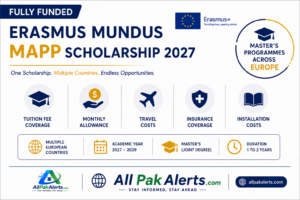
Fully funded Erasmus Mundus scholars typically receive:
✔ Full tuition fee waiver for the entire two-year program
✔ Monthly living stipend of around €1,400 for up to 24 months (roughly €33,600 total)
✔ Health insurance coverage for the duration of the program
✔ Travel and relocation support, including contributions toward installation and subsistence costs
✔ Visa-related financial assistance for scholars who need to relocate internationally
✔ Inclusion support — additional structural or financial assistance for students who may need it
There’s also a partial/institutional scholarship option, which covers 50% of tuition fees for one student per mobility track, for applicants who don’t receive the full award but still want to join the program at a reduced cost. Note that some costs — such as optional study visits, a winter school, or personal travel between your home country and consortium countries — are not covered and are usually estimated at €600–€1,000 per event.
Available Programs
Mundus MAPP offers a single two-year Master’s degree in Public Policy, but with four specialization tracks, each pairing two of the four consortium universities:
- Global Public Policy — Year 1 at CEU (Vienna), Year 2 at IBEI (Barcelona)
- European Public Policy — Year 1 at CEU (Vienna), Year 2 at University of York (UK)
- Political Economy & Development — Year 1 at ISS (Netherlands), Year 2 at IBEI (Spain)
- Governance & Development — Year 1 at ISS (Netherlands), Year 2 at University of York (UK)
There is no bachelor’s, PhD, or postdoctoral track under this specific scholarship — it’s exclusively a joint master’s program.
Eligibility Criteria
To apply, you generally need:
- A bachelor’s degree (minimum three years of study) from a recognized university or institution of higher education
- At least an Upper Second Class (2.1) honors result, or a GPA of roughly B+/3.17 out of 4.0, or an equivalent grade
- A background preferably in social sciences or a related field — degrees purely in natural sciences or engineering are generally not eligible
- English proficiency, unless you’re a native speaker or completed a full degree taught in English; accepted tests include TOEFL iBT (95+), IELTS Academic (7.0+), Cambridge C1/C2, Pearson PTE Academic (76+), or Duolingo (130+), taken within the required validity window
- A place of residence different from the countries in your chosen mobility track at the time of application
- No prior Erasmus Mundus Joint Master’s scholarship and no current EU-funded grant for the same program
- Strong motivation for public policy studies, demonstrated through your statement of purpose
Both EU and non-EU applicants are welcome, and there is no nationality restriction on who can apply.
Required Documents
Prepare the following before you start your application:
- Completed online application form via the Mundus MAPP portal
- Bachelor’s degree certificate (or certificate of enrollment/expected graduation if still studying)
- Academic transcripts (interim transcripts accepted if still completing your degree)
- CV/resume, ideally in Europass format
- Motivation letter (around 500 words), outlining your academic interests, career goals, and preferred mobility track
- Two letters of recommendation
- Proof of English proficiency (unless exempt)
- Proof of current residence (utility bill, rental agreement, or residency certificate)
- Passport copy
- Any documents translated into English with certified translations, if originally in another language
Application Process
Step 1: Review the mobility tracks. Compare the four specialization tracks and pick the one that best matches your academic and career goals.
Step 2: Create an account on the Mundus MAPP application portal. All applications go through Central European University — you cannot apply directly to the other consortium universities.
Step 3: Gather your supporting documents. Start early, especially recommendation letters and transcripts, since they take time to arrange.
Step 4: Complete the online application form. Fill in your personal, academic, and program preference details accurately.
Step 5: Indicate your interest in the scholarship. Make sure to select the scholarship option and submit by the scholarship-specific deadline — self-funded applicants typically have a later deadline.
Step 6: Upload all required documents, including your English test scores, which cannot be submitted late.
Step 7: Wait for the joint consortium review. All four universities assess applications together before releasing scholarship decisions.
Important Dates
| Milestone | Approximate Date (2027 Cohort) |
|---|---|
| Applications Open | Around September 1, 2026 |
| Scholarship Application Deadline | Around December 1, 2026 (confirm via official calendar) |
| Scholarship Decisions Released | Following spring, typically mid-April |
| Self-Funded Decisions | Later in spring/early summer |
| Program Starts | Fall 2027 |
Exact dates for the 2027–2029 cohort are published on the official Mundus MAPP Admissions Calendar once the cycle opens — always confirm before finalizing your plans.
Important Links
- Official Mundus MAPP Website: mundusmapp.org
- Financial Aid Information: mundusmapp.org/financial-aid
- Admissions Requirements: mundusmapp.org/admissions-requirements
- Admissions Checklist: mundusmapp.org/admissions-checklist
- Admissions Calendar: mundusmapp.org/admissions-calendar
- FAQ Page: mundusmapp.org/faq
Selection Process
- Application screening — CEU checks that all required documents and information have been submitted correctly.
- Eligibility check — academic background, English proficiency, and residency requirements are verified.
- Joint qualitative assessment — all four consortium universities review candidates together, evaluating academic strength, motivation, and fit for the chosen mobility track.
- Scholarship ranking — top-ranked eligible candidates are offered full or partial (institutional) scholarships.
- Final selection and offer — successful applicants receive admission and scholarship notifications together.
How to Increase Your Chances for Erasmus Mundus MAPP Scholarship
- Choose a mobility track that genuinely matches your academic background and career goals — reviewers can tell when a track choice feels random
- Write a focused, specific motivation letter rather than a generic one — mention concrete policy issues you want to work on
- Secure recommendation letters from academics or supervisors who know your work well, ideally with a doctoral-level referee
- Apply well before the deadline to leave room for document delays
- If your English test score is borderline, consider retaking it early, since late submissions aren’t accepted
- Highlight any relevant work or research experience in public policy, governance, or international development
Common Mistakes to Avoid
- Submitting English test scores after the deadline (not permitted)
- Applying with a degree in an ineligible field, like pure engineering or natural sciences, without demonstrating strong policy relevance
- Choosing a mobility track without checking the residency eligibility rule for that track
- Submitting a generic motivation letter that doesn’t reflect the specific program or track
- Forgetting to include a certified translation for non-English documents
- Assuming a separate scholarship application is required — scholarship interest is indicated within the main application
Living in Europe (Consortium Countries)
Because Mundus MAPP requires mobility across two countries, your living experience will vary depending on your track. Vienna (Austria) offers a high quality of life with excellent public transport and a strong student community. Rotterdam and The Hague (Netherlands) are known for their international, English-friendly environment and cycling culture. Barcelona (Spain) offers a warmer climate, vibrant street life, and a lower cost of living compared to some other Western European cities. York (UK) is a compact, historic city with a close-knit university atmosphere.
Across all locations, students generally find affordable public transport, active international student communities, and part-time work opportunities, though visa rules on working hours vary by country. Budgeting for cost-of-living differences between your two mobility countries is worth doing early, since prices for housing and daily expenses can shift significantly between cities like Barcelona and Vienna.
Visa Information
Since Mundus MAPP requires study in two different European countries, most non-EU scholars will need to manage two separate student visa or residence permit processes — one for each country in their mobility track. Requirements, processing times, and fees vary by country, so it’s important to start visa preparations as soon as you receive your acceptance letter. The scholarship includes financial assistance to help offset visa-related costs. Students heading to certain tracks (such as those including the Netherlands) may need to provide additional proof of English proficiency specifically for visa purposes, separate from the academic application requirement.
Why Study in Europe (via Mundus MAPP)
- Access to a joint degree recognized across multiple leading European institutions
- Built-in international mobility that broadens your professional network across countries
- A curriculum shaped by four universities with different regional and academic strengths
- Exposure to diverse public policy systems — from EU governance to development economics
- A globally respected credential funded directly by the European Union
Frequently Asked Questions
1. Is the Erasmus Mundus MAPP Scholarship fully funded? Yes, the full scholarship covers tuition, a monthly stipend, health insurance, and travel support; a partial institutional scholarship covering 50% of tuition is also available.
2. Who can apply? Applicants from any country, EU or non-EU, with a relevant bachelor’s degree.
3. Can European students apply? Yes, EU nationals are eligible alongside non-EU applicants.
4. Can African students apply? Yes, applicants from African countries are eligible to apply.
5. Can Asian students apply? Yes, students from any Asian country can apply under the same criteria.
6. Can Pakistani students apply? Yes, Pakistani applicants are eligible, provided they meet the academic and English requirements.
7. Can Indian students apply? Yes, Indian students are eligible to apply for this scholarship.
8. Can Americans apply? Yes, non-EU applicants including U.S. citizens can apply, though native English speakers may be exempt from the English test requirement.
9. Is IELTS mandatory? Yes, unless you’re a native English speaker or completed a full degree taught in English.
10. Can I apply without IELTS? Yes, if you qualify for an exemption or submit an alternative accepted test like TOEFL, Cambridge, PTE, or Duolingo.
11. Is there an application fee? No application fee has been indicated by the consortium for the Mundus MAPP program.
12. Can married students apply? Yes, marital status doesn’t affect eligibility.
13. Can I bring my family? Family/dependent visa policies vary by consortium country, so check the specific rules for your mobility track’s host countries.
14. What GPA is required? Roughly a B+/3.17 out of 4.0, or an Upper Second Class (2.1) honors degree or equivalent.
15. Can I work while studying? Part-time work rules depend on each country’s student visa regulations within your mobility track.
16. How many students are selected? The consortium doesn’t publish a fixed number, but places are limited and competitive across all four tracks combined.
17. Can I apply for multiple programs (tracks)? You choose one mobility track per application; switching later isn’t standard practice.
18. Is age important? There is no stated age limit for applicants.
19. What happens after selection? You’ll receive an admission and scholarship decision, followed by visa preparation for your assigned mobility countries.
20. How competitive is this scholarship? Very competitive, given its EU funding, joint-degree prestige, and global applicant pool.
21. Can I apply with a pending degree? Yes, students still completing their bachelor’s can apply with an interim transcript and expected graduation confirmation, provided they graduate by August 2027.
22. What expenses are not covered? Optional study visits, the winter school, and personal travel between your home country and consortium countries are typically not covered.
23. Can I defer the scholarship? Deferral policies aren’t standard for Erasmus Mundus scholarships; check directly with the CEU admissions office for your situation.
24. Can I apply if I already received an Erasmus Mundus scholarship before? No — applicants who have previously received an Erasmus Mundus Joint Master’s scholarship are not eligible to receive it again.
25. How will I know if I’m selected? Scholarship and admission decisions are communicated together after the joint consortium review, typically in spring.
Final Summary
The Erasmus Mundus MAPP Scholarship 2027 offers a rare combination: a fully funded, EU-backed master’s degree, hands-on international mobility across two countries, and a curriculum built by four respected European universities. If you have a strong academic background in social sciences and a genuine interest in public policy, governance, or development, this is one of the most comprehensive funding packages available for master’s study in Europe. Start preparing your documents early, choose your mobility track carefully, and don’t miss the scholarship deadline — self-funded deadlines come later, but scholarship funding is only available to those who apply on time.