
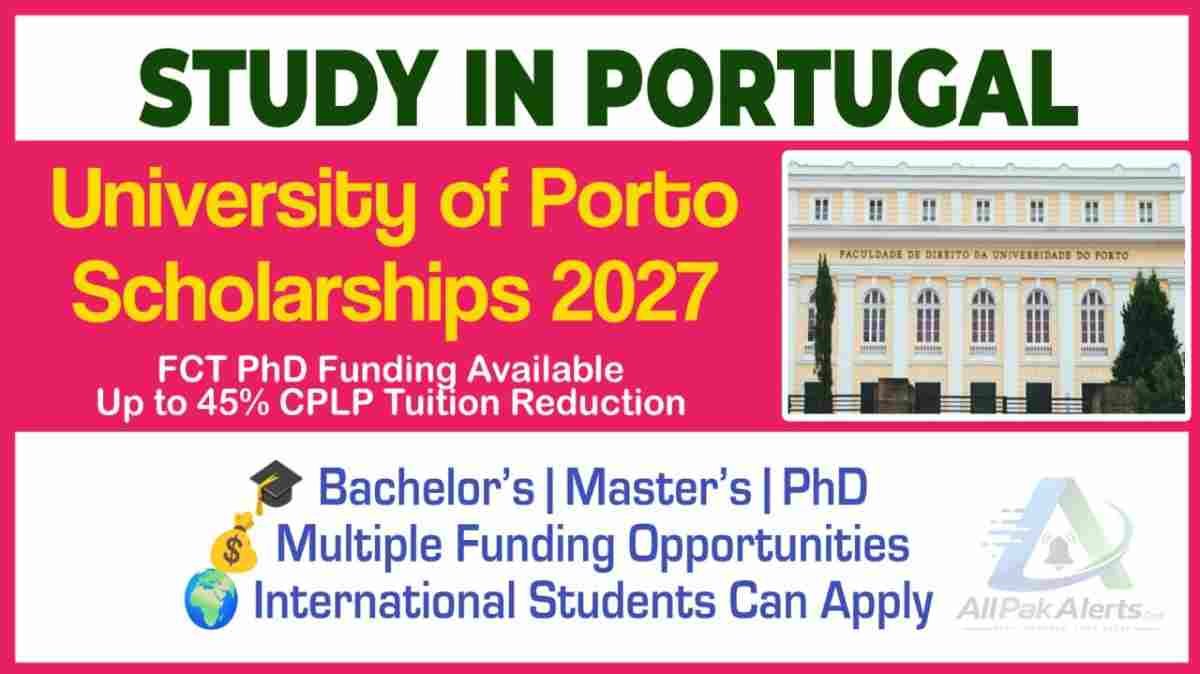
University of Porto Scholarships are not a single award. U.Porto offers several funding routes, including merit scholarships, SASUP support for eligible students, fee reductions for some CPLP nationals, and external research funding. International PhD applicants can also pursue FCT doctoral studentships, which provide a monthly allowance and additional eligible support.
University of Porto Scholarships 2027 Portugal
The University of Porto (U.Porto) offers several forms of financial support for students and researchers, but there is no single scholarship that covers every international applicant. Funding depends on your degree level, nationality, student status, academic performance, and the particular funding programme.
For students planning to study in Portugal in 2027, this distinction matters. Some U.Porto support is available only after enrollment, while other funding comes from external organizations or Portugal’s national research funding agency, the Foundation for Science and Technology (FCT).
For international students, the available options can include university merit awards, faculty-specific incentives, tuition reductions for eligible nationals of Portuguese-speaking countries, and external scholarships. At doctoral level, FCT PhD studentships are an important funding route because applicants of different nationalities can apply when they meet the relevant requirements.
This guide explains the main funding possibilities, who they are intended for, what they cover, and how prospective students should approach the 2027 application cycle.
Quick Overview
| Information | Details |
|---|---|
| University | University of Porto (U.Porto) |
| Country | Portugal |
| Location | Porto |
| Study Levels | Bachelor’s, Master’s, Integrated Master’s and PhD, depending on funding route |
| Main Funding Types | Merit scholarships, SASUP support, fee reductions, incentives and research studentships |
| Major Doctoral Funding Route | FCT PhD Studentships |
| FCT Nationality Eligibility | Portuguese, EU, third-country, stateless and political refugee applicants can be eligible |
| CPLP Fee Reduction | Up to 45% in applicable cases |
| International Bachelor’s/Integrated Master’s Fees | Current U.Porto information lists €3,500–€16,500 for International Student Status, depending on programme/faculty |
| 2027 Deadline | Not officially announced yet |
| Main Application Systems | U.Porto faculty portals and FCT/myFCT, depending on the funding route |
The figures and conditions above can change by academic year and programme. Applicants should always check the official faculty or funding-body information before applying. U.Porto currently states that fees for International Student Status are set by the relevant faculty.
What Are University of Porto Scholarships?
The phrase University of Porto Scholarships describes several different forms of financial assistance rather than one centrally administered international scholarship.
U.Porto itself lists SASUP scholarships, merit scholarships, scientific scholarships and other forms of support. Some opportunities are intended for students already enrolled at the university, while others come from external institutions, government organizations or research partnerships.
This means applicants should not assume that a scholarship advertised under the university’s name automatically provides a full tuition waiver, monthly stipend, accommodation and airfare.
Instead, first identify the funding route that matches your situation.
For example, an international Bachelor’s applicant may need to consider tuition reductions or faculty-level incentives, while a doctoral applicant may be interested in an FCT research studentship. Students who are already enrolled may become eligible for merit-based awards based on their academic results.
Main Funding Options at U.Porto
FCT PhD Studentships
For prospective PhD researchers, the Foundation for Science and Technology (FCT) provides one of the most significant doctoral funding routes associated with study and research in Portugal.
FCT describes its doctoral studentships as funding for research activities leading to a PhD. The regular call covers scientific fields broadly and can support research carried out at eligible academic and scientific institutions. Applicants may include Portuguese citizens, EU citizens, third-country nationals, stateless persons and people with political refugee status.
The funding package can include:
- A monthly maintenance allowance
- Eligible tuition fees
- Support for additional training activities
- Support for presenting work at scientific meetings
- Personal accident insurance
- Installation and travel support where applicable
Because the precise amounts and eligible expenses are governed by FCT regulations, applicants should check the current call and funding table rather than relying on figures from older scholarship articles. FCT updated its studentship amounts for 2026, effective from January 1, 2026.
The 2026 regular FCT call opened on March 2 and closed on March 31. The 2027 call should be checked directly on FCT’s official website once published; the 2026 dates should not be treated as the official 2027 deadline.
CPLP Tuition Fee Reduction
Applicants from countries belonging to the Community of Portuguese-Speaking Countries (CPLP) may qualify for a tuition fee reduction at U.Porto.
The university currently states that nationals of Angola, Brazil, Cape Verde, Guinea-Bissau, Equatorial Guinea, Mozambique, São Tomé and Príncipe, and Timor-Leste may benefit from a reduction of up to 45% of the annual tuition fee in applicable programmes.
This is a tuition reduction, not a fully funded scholarship. It does not automatically mean that living expenses, accommodation, travel or other study costs will be covered.
The exact fee and applicable conditions depend on the programme and faculty, so eligible applicants should confirm the reduction with their target faculty.
Merit Scholarships
U.Porto also awards merit scholarships to students who achieve outstanding academic results.
These awards are different from a conventional scholarship that a new international applicant applies for before admission. According to U.Porto, merit scholarships are awarded annually to enrolled Bachelor’s, Master’s and Integrated Master’s students based on academic achievement. The university also awards Incentive Prizes to the best first-year students of its schools/faculties.
This makes merit funding particularly relevant to students who are already studying at U.Porto and have established a strong academic record.
SASUP Study Scholarships
The Social Support Services of the University of Porto (SASUP) administer study scholarships that provide a monthly financial contribution toward the costs of attending a degree programme.
However, eligibility is important. U.Porto states that Portuguese and EU nationals, stateless persons, and nationals of countries covered by relevant cooperation protocols can be eligible. Students holding International Student Status are excluded from these SASUP study scholarships.
Therefore, a typical non-EU student applying under International Student Status should not assume that SASUP study funding will be available.
Faculty and External Funding
Individual faculties may also offer incentives or other forms of financial support. U.Porto faculties can have their own funding arrangements, while external organizations and research partnerships provide additional opportunities.
U.Porto identifies external support involving organizations and programmes such as FCT, Instituto Camões, Santander Universities, the Calouste Gulbenkian Foundation, UT Austin Portugal, CMU Portugal and MIT Portugal, among others.
Because these opportunities can have separate eligibility rules and deadlines, applicants should investigate funding at both university and faculty level.
Who Can Apply?
There is no single eligibility rule for all University of Porto Scholarships because each funding route has its own conditions.
For FCT doctoral studentships, applicants need to be enrolled in a doctoral programme or meet the requirements necessary to enroll and must propose research leading to a PhD. The 2026 regular call accepted applicants from Portugal, EU member states, third countries, stateless applicants and people with political refugee status.
For U.Porto’s SASUP study scholarships, eligibility is restricted according to nationality/status rules, and International Student Status holders are excluded.
For CPLP fee reductions, nationality is central. Applicants must belong to an eligible CPLP country and meet the conditions applicable to their programme.
For merit scholarships, the relevant factor is academic performance after enrollment at U.Porto.
International applicants should therefore avoid using one funding route’s eligibility requirements as if they applied to every scholarship offered at the university.
Study Levels and Available Programs
U.Porto offers programmes across multiple academic levels, including Bachelor’s, Master’s, Integrated Master’s and doctoral studies.
However, the funding available at each level is different.
International Bachelor’s and Integrated Master’s applicants are generally admitted through the relevant international-student process, while tuition fees are determined by the faculty. U.Porto currently indicates that fees for students covered by International Student Status can range from €3,500 to €16,500 for Bachelor’s and Integrated Master’s programmes, depending on the course and faculty.
Master’s and doctoral tuition is also determined according to the applicable programme and student status.
Students interested in a specific field should therefore check the individual course page rather than relying on a university-wide fee figure.
What Funding Can You Receive?
The financial support available depends entirely on the route you qualify for.
Possible support includes:
- Tuition fee reductions
- Monthly study support
- Merit-based cash awards
- Research studentship payments
- Eligible tuition costs for FCT-funded doctoral students
- Support for research-related activities
- Conference or scientific-meeting support
- Travel or relocation support where applicable under an FCT studentship
- Personal accident insurance under applicable FCT funding
Not every applicant receives all of these benefits.
For example, a CPLP fee reduction reduces tuition but is not equivalent to a full scholarship. Likewise, a merit award is a university prize based on academic performance rather than a comprehensive package covering all study expenses.
FCT’s doctoral funding provides a broader package of support, but applicants should still read the applicable regulations to understand exactly which expenses are covered and under what conditions.
Required Documents
The documents you need depend on the programme and funding route.
For admission, applicants may be asked for documents such as:
- Passport or identification document
- Academic transcripts
- Degree certificates
- Proof of previous education
- Language evidence where required by the programme
- CV or other academic information
- Programme-specific documents
Doctoral funding applications may require additional research-related material. FCT’s call documentation specifies the supporting documents and application requirements for each competition.
If you are applying for a CPLP tuition reduction, proof of nationality may be required.
For SASUP support, applicants may need documents establishing their eligibility and financial circumstances.
Do not prepare a generic scholarship document package and assume it will meet every requirement. The safest approach is to check the official notice for the exact programme and funding route.
How to Apply for University of Porto Scholarships
The application process depends on the type of support you want.
1. Identify your funding route.
Start by determining whether you are applying for a U.Porto degree, an FCT PhD studentship, a merit award, a fee reduction or another funding programme.
2. Check your programme requirements.
Visit the relevant U.Porto faculty page and confirm the admission conditions, tuition fees and application dates for your chosen course.
3. Apply for admission where required.
International applicants should follow the application procedure published by their target faculty. U.Porto explains that International Student Status applicants use the special international-student application process.
4. Prepare separate funding documents.
If your funding route requires a research proposal, proof of nationality, financial documents or other materials, prepare them according to the relevant funding body’s instructions.
5. For FCT doctoral funding, use myFCT.
FCT requires applications for its doctoral studentship call to be submitted online through the myFCT platform. The 2026 call was submitted exclusively through myFCT.
6. Check your faculty for additional incentives.
Some support is administered directly by individual faculties, so admission to U.Porto does not necessarily mean that every funding opportunity will appear in one central application.
7. Submit before the applicable deadline.
Save confirmation of your application and retain copies of submitted documents.
For 2027, applicants should wait for the official calls and faculty notices rather than relying on deadlines copied from older scholarship websites.
Important Dates for 2027
At the time of writing, the official 2027 deadlines for the main funding routes have not been published.
The most useful current reference is the 2026 cycle. FCT’s 2026 regular PhD studentship call opened on March 2 and closed on March 31, while U.Porto’s international admission deadlines are set through individual faculty calls.
| Funding Route | 2027 Status |
|---|---|
| FCT PhD Studentships | 2027 call not yet announced |
| U.Porto International Admissions | Faculty-specific dates; check the relevant programme |
| CPLP Fee Reduction | Confirm with the target faculty |
| SASUP Scholarships | Annual schedule published by SASUP |
| Merit Scholarships | Relevant to enrolled students |
Do not treat the 2026 dates as confirmed 2027 deadlines.
Selection Process
Selection also varies according to the funding programme.
For FCT doctoral studentships, applications are evaluated against published criteria. In the 2026 regular call, FCT described assessment in terms of the applicant’s merit, the merit of the proposed work plan and the quality of the hosting conditions. Applications are ranked according to the published evaluation framework.
Merit scholarships at U.Porto are linked to academic achievement after enrollment.
SASUP scholarships are assessed under their own eligibility and financial-support rules.
Faculty incentives may use admission rankings or other criteria established by the relevant faculty.
Applicants should therefore read the selection rules attached to the specific funding route rather than assuming that admission to U.Porto automatically results in scholarship selection.
How to Prepare a Strong Application
A strong application starts with choosing the correct funding route.
For doctoral applicants, spend time understanding the research area and preparing a focused research plan that matches the proposed programme and supervisor. Make sure the academic and research information in your application is complete and consistent.
For Bachelor’s and Master’s applicants, pay close attention to the admission requirements of the faculty you are applying to. If you are eligible for a CPLP tuition reduction, confirm the process before paying or arranging your tuition.
It is also useful to check funding before making financial plans. A tuition discount may reduce your academic costs but will not necessarily cover accommodation, food, transportation or travel.
Finally, check every deadline directly with the organization responsible for the funding. U.Porto and FCT operate separate application systems and schedules.
Common Mistakes to Avoid
Applicants researching University of Porto Scholarships should avoid several common misunderstandings:
- Treating U.Porto funding as one single scholarship
- Assuming every international student can apply for SASUP support
- Calling a tuition discount a fully funded scholarship
- Assuming merit scholarships are available to applicants before enrollment
- Using old FCT deadlines as the 2027 deadline
- Assuming the same tuition fee applies to every U.Porto course
- Failing to check the relevant faculty’s admission notice
- Applying through unofficial scholarship websites
- Assuming accommodation and airfare are automatically included
- Ignoring the separate requirements of external funding programmes
These mistakes can lead to unrealistic financial planning, especially for international students.
Studying in Porto
The University of Porto is located in Porto, a major Portuguese university city with a large student population and an established international academic community.
U.Porto provides accommodation through university residences, although availability and eligibility depend on the relevant student category and residence allocation process. The university also provides information about accommodation and student support services.
Students should prepare a separate budget for expenses that are not covered by their specific funding package. Even when tuition or research costs are funded, students may still need money for housing, food, transportation and personal expenses.
Visa Information for International Students
Students from outside the EU generally need to follow Portugal’s current student immigration and visa requirements after receiving admission.
Visa requirements can depend on nationality, programme length and individual circumstances. Applicants should therefore use the current information provided by the Portuguese authorities and the relevant Portuguese diplomatic mission rather than relying on old scholarship articles.
Admission to U.Porto or receiving funding does not itself guarantee visa approval.
Why Consider the University of Porto?
U.Porto can be relevant to international applicants for several reasons:
- It offers programmes across a broad range of academic fields.
- It has established research activity and international partnerships.
- International applicants can apply through dedicated admission procedures.
- Some students may qualify for tuition reductions or university-level financial support.
- Doctoral researchers can pursue FCT funding where their research and application meet the relevant criteria.
- Students already enrolled may have access to merit-based awards.
The key point is that the financial pathway depends on the student’s individual circumstances rather than on one universal scholarship package.
Frequently Asked Questions
1. Is University of Porto Scholarships 2027 fully funded?
There is no single U.Porto scholarship that is fully funded for all applicants. FCT doctoral studentships can provide a substantial funded package for eligible PhD researchers, while other U.Porto opportunities may provide tuition reductions, merit awards or monthly support.
2. Can international students apply for funding at U.Porto?
Yes, some funding routes are open to international students. However, eligibility varies. For example, International Student Status holders are excluded from SASUP study scholarships, while FCT doctoral studentships can accept third-country nationals who meet the requirements.
3. Can Pakistani students apply to the University of Porto?
Pakistani students can apply for U.Porto programmes subject to the admission requirements of their chosen course. For funding, eligibility depends on the particular scholarship or studentship. Pakistani nationality does not qualify for the CPLP tuition reduction because Pakistan is not a CPLP member.
4. Is there a full scholarship for Bachelor’s students?
U.Porto does not present one universal fully funded Bachelor’s scholarship for all international applicants. International students should check faculty-specific incentives, fee reductions where applicable and external funding.
5. Can Master’s students receive financial support?
Yes. U.Porto lists several forms of support, including merit scholarships and faculty or external funding. Eligibility and availability depend on the programme and student’s status.
6. Are FCT PhD studentships open to international applicants?
Yes. The 2026 FCT regular doctoral call explicitly included third-country nationals, as well as Portuguese and EU citizens, stateless applicants and people with political refugee status.
7. What does FCT doctoral funding cover?
The FCT package can include a monthly maintenance allowance, eligible tuition fees, additional training support, scientific-meeting support, personal accident insurance and applicable travel or installation support. The exact conditions are determined by the relevant regulations and call.
8. How much is the FCT PhD stipend?
FCT updated its studentship amounts for 2026. Because rates can change annually, applicants should use the current FCT studentship amount table rather than an older figure quoted on scholarship websites.
9. Is IELTS required?
There is no single IELTS rule for all U.Porto programmes. Language requirements depend on the programme and its admission rules. Applicants should check the language requirements published by their target faculty.
10. Can I study without IELTS?
That depends on the programme and how it assesses language proficiency. Do not assume that IELTS is automatically waived or automatically required. Check the official admission requirements of the chosen course.
11. What is the CPLP tuition reduction?
Eligible nationals of CPLP countries may receive a tuition reduction of up to 45% in applicable U.Porto programmes. It is a fee reduction rather than a full scholarship.
12. Which countries are included in the CPLP group?
The U.Porto information lists Angola, Brazil, Cape Verde, Guinea-Bissau, Equatorial Guinea, Mozambique, São Tomé and Príncipe, and Timor-Leste.
13. Are SASUP scholarships available to International Student Status holders?
No. U.Porto specifically states that students with International Student Status are excluded from SASUP study scholarships.
14. Are merit scholarships available before admission?
Merit scholarships are associated with academic achievement by students already enrolled at U.Porto. They should not be treated as a guaranteed pre-admission scholarship for new applicants.
15. Does U.Porto provide accommodation?
U.Porto has student residences and accommodation support, but availability and allocation depend on the applicable rules. Accommodation should not automatically be assumed to be included in a scholarship package.
16. Does the scholarship cover airfare?
Not all U.Porto funding covers airfare. FCT studentships can include travel support where applicable under the relevant rules, but applicants should check the specific FCT conditions.
17. What are the 2027 application deadlines?
The main 2027 deadlines have not yet been officially published. FCT’s 2026 regular PhD call ran from March 2 to March 31, but those dates should not be presented as confirmed 2027 deadlines.
18. Where do I apply for an FCT PhD studentship?
FCT doctoral studentship applications are submitted through the official myFCT platform during an open call.
19. Can I apply for more than one funding opportunity?
Potentially, but each programme has its own rules concerning eligibility and combining financial support. Read the regulations for each funding source before accepting multiple awards.
20. Where can I find the latest U.Porto funding information?
The U.Porto Scholarships and Funding page is the central starting point for university-level financial support. For doctoral research funding, applicants should also monitor FCT’s official doctoral studentship pages and myFCT.
Official Source
University of Porto — Scholarships and Funding
U.Porto’s official page explains SASUP scholarships, merit scholarships and other forms of financial support.
U.Porto Scholarships and Funding
University of Porto — International Students
Use the official international-student page to check admission procedures, tuition information and applicable fee reductions.
U.Porto International Student Applications
FCT — PhD Studentships
FCT publishes the official doctoral studentship calls, eligibility requirements, funding conditions and application information.
FCT PhD Studentships
myFCT Application Portal
The official FCT platform is used for submitting applications during open calls.
myFCT Portal
Final Thoughts
University of Porto Scholarships 2027 cover several different funding opportunities rather than one universal scholarship. International students should first identify their degree level and student status, then check whether they qualify for a university award, tuition reduction, faculty incentive or external funding.
For prospective PhD researchers, FCT doctoral studentships are particularly relevant because the programme accepts applicants from multiple nationalities and can provide monthly and additional eligible support. For Bachelor’s and Master’s applicants, financial planning is especially important because tuition and funding conditions can vary by faculty.
Before applying, check the latest official U.Porto and FCT announcements for the 2027 cycle, confirm the exact eligibility requirements, and use only the official application channels.