
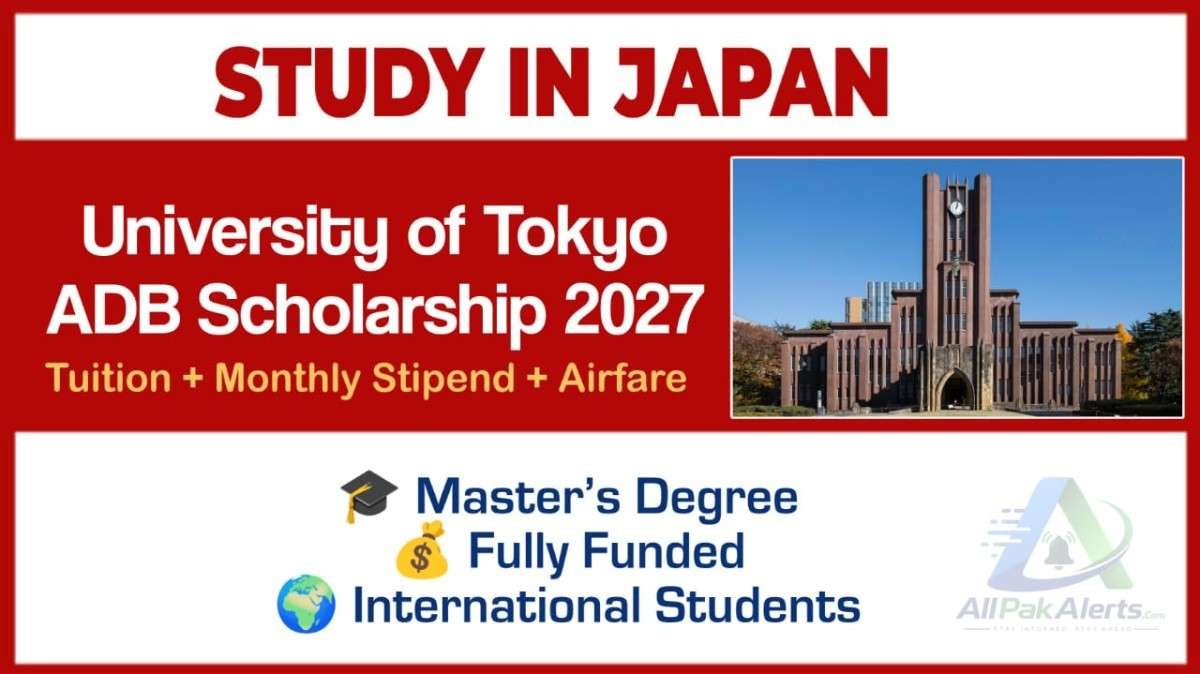
University of Tokyo ADB Scholarship 2027 Japan
The University of Tokyo ADB Scholarship is a master’s scholarship opportunity offered through the Asian Development Bank–Japan Scholarship Program (ADB-JSP). The program is funded by the Government of Japan and administered by the Asian Development Bank (ADB), while participating universities select and nominate scholarship candidates.
The University of Tokyo is one of the participating institutions in Japan. Its approved ADB-JSP routes include selected master’s programs in areas such as civil engineering and infrastructure development, urban engineering, environment, international studies, sustainability science, international health, and public policy. The exact programs and deadlines depend on the University of Tokyo graduate school or department.
For the 2027 academic year, several University of Tokyo schools have already published program-specific information. For example, the Graduate School of Frontier Sciences has published its 2027 autumn admission information and gives a December 10, 2026 application deadline for several eligible departments and programs. The School of International Health has separately published an ADB-JSP 2027 deadline of June 30, 2026, meaning that its 2027 application window has already passed.
This difference is important: there is not one universal University of Tokyo ADB Scholarship deadline. Applicants must check the deadline for the specific University of Tokyo program they want to enter.
Quick Overview
| Detail | Information |
|---|---|
| Scholarship | University of Tokyo ADB Scholarship |
| Program | Asian Development Bank–Japan Scholarship Program |
| Funding | Government of Japan, administered by ADB |
| University | The University of Tokyo |
| Country | Japan |
| Degree | Master’s degree |
| Eligible applicants | Citizens of eligible ADB borrowing member countries |
| Study areas | Selected development-related master’s programs |
| Scholarship duration | Normally up to 2 years |
| Application method | Apply through the relevant University of Tokyo school/program |
| Deadline | Varies by graduate school and program |
| 2027 intake | Program-specific |
Table of Contents
- What Is the University of Tokyo ADB Scholarship?
- Who Can Apply?
- University of Tokyo ADB Scholarship Eligibility
- Eligible Fields and Programs
- Funding and Benefits
- Required Documents
- How to Apply
- Important Dates
- Selection Process
- Practical Tips for Applicants
- Common Mistakes to Avoid
- Current Application Status
- Frequently Asked Questions
- Official Sources
- Final Thoughts
What Is the University of Tokyo ADB Scholarship?
The University of Tokyo ADB Scholarship is not a separate scholarship created independently by the university. It is an ADB-Japan Scholarship Program placement at the University of Tokyo.
The ADB-JSP supports graduate study for citizens of eligible ADB borrowing member countries. The program focuses on fields connected with economic and social development, including economics, management, health, education, agriculture, environment, natural-resource management, science and technology, and other development-related areas.
The University of Tokyo is included among the ADB-JSP’s designated academic institutions in Japan. ADB’s current institutional list identifies several University of Tokyo programs that participate in the scholarship scheme.
Applicants therefore need to think about two connected parts of the process:
- Admission to an eligible University of Tokyo master’s program.
- Consideration for the ADB-JSP scholarship through the relevant university program.
The scholarship is intended for master’s-level study. ADB’s official FAQ states that the program does not fund doctoral study, undergraduate study, distance-learning programs, short courses, conferences or seminars.
Another important point is that applicants do not normally submit a separate scholarship application directly to ADB. The application is handled through the participating academic institution, which evaluates and nominates candidates to ADB.
Who Can Apply?
The ADB-JSP is designed for nationals of eligible ADB borrowing member countries and Japanese ODA scholarship-eligible countries.
The current ADB list includes countries such as:
- Bangladesh
- Bhutan
- Cambodia
- Fiji
- Georgia
- India
- Indonesia
- Kazakhstan
- Kyrgyz Republic
- Malaysia
- Maldives
- Mongolia
- Nepal
- Pakistan
- Philippines
- Sri Lanka
- Thailand
- Timor-Leste
- Uzbekistan
- Viet Nam
The complete eligibility list should always be checked on the official ADB website because participating-country rules can change.
Applicants also need to meet the admission requirements of the particular University of Tokyo graduate school. Meeting the general ADB requirements alone does not guarantee admission to the university or selection for the scholarship.
University of Tokyo ADB Scholarship Eligibility
The ADB-JSP establishes general scholarship requirements, while the University of Tokyo program adds its own academic and admission conditions.
According to ADB, applicants generally must:
- Be a national of an eligible ADB borrowing member country and Japanese ODA scholarship-eligible country.
- Not hold dual citizenship of a developed country.
- Have gained admission to an approved master’s course at a designated institution.
- Hold a bachelor’s degree or equivalent with a strong academic record.
- Have at least two years of full-time professional work experience gained after completing a university degree.
- Have sufficient English communication ability for graduate study.
- Normally be no more than 35 years old at the time of application.
- Be in good health.
- Agree to return to their home country after completing the scholarship and work there for at least two years.
- Not be an ADB executive director, alternate director, management, staff member or consultant, or a close relative of someone in those categories.
- Not be a staff member of an ADB-JSP designated institution.
- Normally be living and working in their home country rather than another country.
- Not already be enrolled in a graduate degree program.
The University of Tokyo may impose additional conditions depending on the graduate school.
For example, the Graduate School of Frontier Sciences states that applicants must satisfy the ADB-JSP requirements and seek admission to one of its eligible master’s departments or programs. It also states that applicants over 35 cannot be recommended by that school.
This is why applicants should read both sets of requirements: the ADB-JSP eligibility rules and the University of Tokyo program’s admission guidelines.
Work experience requirement
The two-year professional experience requirement deserves particular attention.
ADB specifies that the required experience must be full-time professional work acquired after completion of a university degree. Work performed during undergraduate study does not count as the required post-degree professional experience.
The University of Tokyo Graduate School of Frontier Sciences also explains that research-assistant work performed while studying for an undergraduate degree does not satisfy this ADB-JSP professional-experience requirement.
Eligible Fields and Programs
The University of Tokyo does not offer the ADB-JSP across every master’s degree.
ADB’s current designated-institution list identifies several University of Tokyo programs, including:
Graduate School of Frontier Sciences
Eligible areas listed by the university include master’s programs in:
- Materials Science
- Advanced Energy
- Integrated Biosciences
- Natural Environmental Studies
- Ocean Technology, Policy, and Environment
- Environment Systems
- Human and Engineered Environmental Studies
- Socio-Cultural Environment Studies
- International Studies
- Graduate Program in Sustainability Science
The exact departments and program arrangements should be checked against the current 2027 admission guidelines.
School of International Health
The University of Tokyo’s School of International Health, within the Graduate School of Medicine, offers the ADB-JSP for its master’s-level international health program.
The school states that the program begins in April and that selected ADB-JSP scholars can receive support for a two-year master’s course.
Graduate School of Public Policy
ADB’s institutional list includes the Master of Public Policy, International Program at the University of Tokyo’s Graduate School of Public Policy.
Other University of Tokyo programs
ADB’s institutional list also includes:
- Master in Civil Engineering and Infrastructure Development
- Master in Urban Engineering
- Master in Environment Studies
- Master in International Studies
- Master in Sustainability Science
- Master in Health Science (International Health)
- Master of Public Policy, International Program
Because the approved programs and deadlines are connected to individual graduate schools, applicants should not assume that all University of Tokyo master’s programs qualify for ADB-JSP funding.
Funding and Benefits
The ADB-Japan Scholarship Program provides substantial financial support for successful scholars.
ADB lists the following main benefits:
- Full tuition fees
- Monthly subsistence allowance, including housing support
- Allowance for books and instructional materials
- Medical insurance
- Travel expenses
For students conducting research, a special thesis-preparation grant may be available. ADB also states that, in special circumstances, support may be provided for computer literacy, preparatory language and similar courses.
The University of Tokyo School of International Health gives a specific example for its ADB-JSP 2027 program. It states that the scholarship covers:
- Round-trip travel between the scholar’s home country and Japan
- Entrance fees
- Tuition fees
- Subsistence allowance of 147,000 yen per month
- Other applicable allowances
The exact benefit package should therefore be checked against the program-specific University of Tokyo information and the ADB-JSP regulations applicable to the applicant.
Scholarship duration
ADB states that the scholarship is normally awarded for one year with a possible extension into the second year, provided the scholar maintains satisfactory academic performance.
The maximum scholarship duration for a master’s program is two years.
What the scholarship does not cover
The ADB-JSP does not cover expenses for the scholar’s family or dependents.
ADB also states that the program does not generally cover additional travel during the study period, extracurricular courses or training, supplementary educational materials, field trips, workshops, seminars, internships or the purchase of educational equipment such as computers.
Applicants should therefore avoid interpreting “funded” as meaning every personal expense will automatically be paid.
Required Documents
Document requirements vary by University of Tokyo graduate school and admission route.
ADB’s application procedures state that applicants generally submit the completed institutional application together with required scholarship documentation and academic records.
The ADB-JSP application may also require financial documentation. ADB’s official procedures state that applicants should submit their latest income-tax return or available salary certification and a certification of family income.
University of Tokyo programs can require additional documents.
Depending on the selected program, applicants may need items such as:
- Bachelor’s degree certificate
- Academic transcripts
- Passport or identification document
- Curriculum vitae
- Research or study plan
- Recommendation letters
- English-language test results
- Program-specific application forms
- ADB-JSP information sheet
- Income-related documentation
The exact list should be taken from the current admission checklist for the selected University of Tokyo graduate school.
For example, the School of International Health specifically requires an official TOEFL iBT score report or IELTS result verification for its ADB-JSP application.
Applicants should not assume that the same document list applies to every University of Tokyo program.
How to Apply
The application process is different from applying directly to ADB.
Step 1: Choose an eligible University of Tokyo program
Start by identifying a University of Tokyo master’s program that is currently designated for ADB-JSP.
Check the program’s academic field, intake, supervisor requirements and admission conditions.
Step 2: Check the ADB-JSP eligibility rules
Before spending time on the application, confirm that you meet the general ADB requirements, particularly:
- Citizenship
- Age
- Bachelor’s degree
- Academic record
- Two years of post-degree professional experience
- English proficiency
- Current residence/work conditions
- Return-to-home-country requirement
Step 3: Read the University of Tokyo admission guidelines
Each graduate school can have its own application procedure.
The Graduate School of Frontier Sciences, for example, has separate admission arrangements for its 2027 autumn intake and instructs applicants to check whether an appropriate academic supervisor is available.
Step 4: Identify a suitable academic supervisor when required
Some University of Tokyo programs require applicants to identify or contact a prospective supervisor before completing the admission process.
Follow the instructions of your specific graduate school rather than using a general University of Tokyo procedure.
Step 5: Prepare the application documents
Collect your academic records, identification documents, recommendation letters, English-language evidence and any research or study documents required by your selected program.
Prepare financial documents required by ADB where applicable.
Step 6: Submit the university application
Submit the application to the University of Tokyo graduate school according to its published instructions and deadline.
The deadline is not necessarily the same across all University of Tokyo ADB-JSP programs.
Step 7: Request consideration for ADB-JSP
Where the program’s procedure requires it, indicate that you wish to be considered for ADB-JSP funding.
ADB explains that applicants should apply to the participating academic institution and identify their interest in the ADB-JSP.
Step 8: Complete the university’s screening
The university first evaluates applicants according to its admission and scholarship-selection procedures.
Only applicants who meet the relevant requirements and are selected for nomination proceed to the ADB stage.
Step 9: ADB reviews nominated candidates
The university submits its selected candidates to ADB.
ADB then conducts its own review, after which the final scholarship decision is communicated to the institution.
There is therefore no separate general ADB application that replaces the University of Tokyo admission process.
Important Dates
There is no single deadline for every University of Tokyo ADB-JSP program.
ADB’s institutional list gives different normal deadlines for different University of Tokyo programs. The 2027 program information published by individual University of Tokyo schools should take priority for the specific course you want.
| University of Tokyo program | 2027-related deadline/status |
|---|---|
| School of International Health | June 30, 2026, 17:00 JST |
| Graduate School of Frontier Sciences — several eligible programs | December 10, 2026 |
| Graduate School of Frontier Sciences — Integrated Biosciences Schedule B | Application period in November 2026; follow the program’s entrance-examination schedule |
| Other University of Tokyo ADB-JSP programs | Check the individual graduate school |
The School of International Health’s June 30, 2026 deadline has already passed for the 2027 intake.
By contrast, the Graduate School of Frontier Sciences has published 2027 autumn admission information stating that applications for several eligible departments and the Sustainability Science program are due by December 10, 2026.
Applicants should therefore avoid using a single “University of Tokyo ADB Scholarship deadline” for all programs.
Selection Process
The selection process involves both the university and ADB.
First, the relevant University of Tokyo graduate school reviews applications according to its admission and selection criteria.
The Graduate School of Frontier Sciences describes a preliminary university screening. Applicants who pass that screening and meet ADB-JSP eligibility requirements are then informed about the scholarship application procedure.
The university subsequently nominates scholarship candidates to ADB.
ADB reviews the candidates submitted by participating institutions and recommends awardees according to its scholarship selection criteria. Final approval is then handled through the program’s formal process.
ADB states that selection can consider factors including academic qualifications, the institution’s ranking of candidates, financial circumstances, gender diversity, nationality diversity, professional background and the applicant’s potential contribution to development in their home country.
Meeting the minimum eligibility conditions does not guarantee a scholarship award.
Practical Tips for Applicants
Choose the program before preparing the scholarship application
The University of Tokyo has multiple ADB-JSP routes. Start with the degree program rather than searching for one general university-wide application.
Check the deadline twice
A deadline listed by ADB may be a general institutional reference. The graduate school’s own current admission instructions should be checked for the exact 2027 intake.
Pay attention to professional experience
ADB’s two-year work-experience condition applies to professional work gained after completing a university degree. Undergraduate research or employment performed during the degree should not automatically be counted.
Prepare your English-language evidence early
Some University of Tokyo programs have specific TOEFL or IELTS requirements. Check the exact test and reporting method required by your program.
Research your intended supervisor
Where the graduate school requires applicants to identify a prospective supervisor, review faculty research areas before applying.
Keep scholarship and admission requirements together
You may satisfy ADB’s general eligibility requirements but still fail to meet the academic or application requirements of your chosen University of Tokyo program.
Do not rely on old scholarship lists
ADB-JSP participating institutions and approved programs can change. Always compare older scholarship articles with the latest official ADB and University of Tokyo information.
Common Mistakes to Avoid
Applying to an ineligible master’s program
The ADB-JSP only supports approved programs at participating institutions. A normal University of Tokyo master’s program is not automatically an ADB-JSP program.
Assuming the scholarship covers a PhD
The ADB-JSP is a master’s scholarship. The University of Tokyo’s Graduate School of Frontier Sciences also explicitly states that doctoral applicants are not eligible for this scholarship route.
Using one deadline for the entire university
University of Tokyo ADB-JSP deadlines vary by graduate school and program.
Applying directly to ADB instead of following university instructions
ADB states that applicants apply through designated academic institutions. The university screens candidates and nominates them to ADB.
Ignoring the two-year work requirement
Applicants need qualifying full-time professional experience after completing a university degree.
Assuming family expenses are covered
ADB states that the scholarship does not cover expenses for dependents.
Treating admission as a scholarship guarantee
Admission to a University of Tokyo program does not automatically mean that the applicant will receive an ADB-JSP award.
Current Application Status
The University of Tokyo ADB Scholarship 2027 is program-specific and has different application statuses depending on the graduate school.
The School of International Health has already closed its ADB-JSP 2027 application window, with a deadline of June 30, 2026.
The Graduate School of Frontier Sciences has published 2027 autumn admission information, with a December 10, 2026 deadline for several eligible departments and the Sustainability Science program. The Integrated Biosciences route follows a separate November entrance-examination schedule.
Therefore, applicants should not describe the entire University of Tokyo ADB Scholarship 2027 as simply “open” or “closed.” The correct status depends on the specific master’s program.
Frequently Asked Questions
1. What is the University of Tokyo ADB Scholarship?
It is an ADB-Japan Scholarship Program opportunity available through selected master’s programs at the University of Tokyo. The scholarship is funded by the Government of Japan and administered by the Asian Development Bank.
2. Is the University of Tokyo ADB Scholarship fully funded?
The ADB-JSP provides major financial support, including tuition, a subsistence and housing allowance, books and instructional materials, medical insurance and travel expenses. Specific benefits should be checked against the applicable program and scholarship regulations.
3. Can Pakistani students apply for the ADB-JSP at the University of Tokyo?
Yes. Pakistan appears on the current ADB-JSP list of eligible countries. Applicants must also satisfy the general ADB requirements and the admission conditions of the selected University of Tokyo master’s program.
4. What degree does the scholarship support?
The ADB-JSP supports master’s-level graduate study. It does not normally support doctoral study or undergraduate degrees.
5. Do I apply directly to ADB?
No. Applicants apply through the participating academic institution. The University of Tokyo graduate school evaluates applicants and nominates candidates to ADB for scholarship consideration.
6. How much is the monthly allowance?
ADB describes the scholarship as providing a monthly subsistence allowance that includes housing support. The University of Tokyo School of International Health currently states a subsistence allowance of 147,000 yen per month for its ADB-JSP program. Amounts can depend on the applicable program and current scholarship rules.
7. What is the deadline for the University of Tokyo ADB Scholarship 2027?
There is no single deadline for all University of Tokyo programs. For example, the School of International Health had a June 30, 2026 deadline, while the Graduate School of Frontier Sciences has a December 10, 2026 deadline for several 2027 autumn routes. Applicants must check their specific program.
8. Does the scholarship cover family or dependent expenses?
No. ADB states that the ADB-JSP provides funding for the scholar and does not cover expenses for the scholar’s spouse or other dependents.
Official Sources
- Asian Development Bank — ADB-Japan Scholarship Program FAQs
ADB-JSP Official FAQs - Asian Development Bank — Participating Academic Institutions
ADB-JSP Participating Institutions - Asian Development Bank — Application Procedures
ADB-JSP Application Procedures - University of Tokyo — School of International Health, ADB-JSP 2027
University of Tokyo School of International Health — ADB-JSP 2027 - University of Tokyo — Graduate School of Frontier Sciences, ADB-JSP
University of Tokyo Graduate School of Frontier Sciences — ADB-JSP
Final Thoughts
The University of Tokyo ADB Scholarship is a master’s-level funding route under the ADB-Japan Scholarship Program for eligible citizens of ADB member countries. It can provide substantial support for tuition, living expenses, travel, insurance and other approved costs.
The most important point for 2027 applicants is that the University of Tokyo does not have one universal ADB-JSP deadline. Different graduate schools and programs use different admission schedules. Some 2027 applications have already closed, while other program-specific deadlines remain ahead.
Before applying, check the current ADB-JSP eligibility rules and the admission guidelines for your exact University of Tokyo master’s program. Pay particular attention to the two-year post-degree work-experience requirement, age limit, English-language requirements, supervisor requirements and program-specific deadline.